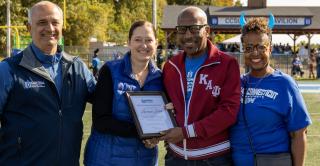
Central honors Admissions Director Larry Hall with Distinguished Service Award


Candidates are evaluated in two areas: professional dispositions and instructional practice. Review these expectations with your cooperating teacher and university supervisor throughout the placement.
| Area | What This Looks Like |
|---|---|
| Professional Growth | Participates in professional learning, reflects on it, and applies new learning. |
| Communication with Families | Communicates professionally with families and shares information that supports student progress. |
| Punctuality | Arrives on time for daily teaching and other professional responsibilities. |
| Deadlines and Obligations | Meets responsibilities, communicates absences, and provides plans when absent. |
| Preparation | Comes prepared with organized plans, materials, and resources; remains flexible. |
| Collaboration | Works productively with the cooperating teacher and school community. |
| Advocacy | Recognizes learner or professional needs and takes appropriate action. |
| Response to Feedback | Receives feedback professionally and uses it to improve practice. |
| Area | What This Looks Like |
|---|---|
| Focus for Learning | Plans measurable, appropriate goals and aligns objectives, activities, and outcomes. |
| Materials and Resources | Selects relevant, accessible resources that support learning goals and learner needs. |
| Assessment of Learning | Plans varied, culturally relevant ways for students to demonstrate learning and growth. |
| Differentiated Methods | Connects learning to prior knowledge and adapts instruction for diverse learners. |
| Learning Targets and Directions | Communicates accurate targets, clear directions, and a logical lesson sequence. |
| Critical Thinking | Engages students in problem solving, conceptual connections, and questioning assumptions. |
| Checking for Understanding | Uses formative assessment and adjusts instruction in response to student needs. |
| Digital Tools | Uses appropriate technology to support goals, engagement, and demonstration of learning. |
| Learning Environment | Creates a safe, respectful classroom with effective routines, relationships, and engagement. |
| Data-Guided Instruction | Uses student data and appropriate tools to plan instruction and set goals. |
| Feedback to Learners | Provides timely, clear, descriptive, and actionable feedback. |
| Assessment Techniques | Uses varied, developmentally appropriate formative and summative assessments. |
| Research and Theory | Connects instructional decisions and student progress to educational research or theory. |
| Area | What This Looks Like |
|---|---|
| 3 – Exceeds Expectations | Exemplary, consistent performance that often goes beyond expected practice. |
| 2 – Meets Expectations | Consistently demonstrates expected performance for a teacher candidate. |
| 1 – Emerging | Developing skill; additional support or consistency is needed. |
| 0 – Does Not Meet Expectations | Expected practice is not yet demonstrated; significant improvement is needed. |
The full CPAST evaluation is located in the SL&L platform.