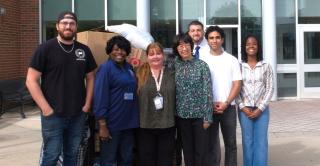
Fresh fashions fill Career Closet

Central was awarded a Connecticut Tech Talent Accelerator Innovation Grant for $75,000 earlier this month that will address a growing workforce gap: Employees who not only know how to find information, but also how to determine what information can be trusted and how to explain that to people who might not be experts in a given field.
The grant, awarded by the Business-Higher Education Forum and the New England Board of Higher Education, with support from the Connecticut Office of Workforce Strategy, will support the development of a new three-credit course, Translational Literacy in Science.
Led by principal investigator Dr. Caleb Bragg, the course will teach students to evaluate evidence across disciplines and translate complex technical information for non-specialist audiences through Scientific Communication + AI Literacy Experience (SCALE) training. SCALE will teach students to scrutinize information from vendors, clinical summaries, and AI-generated documents and trace the claims back to primary sources. From there, they will be able to distinguish what the evidence supports, identify what has been missed or overstated, and communicate remaining uncertainties.
Bragg notes, “Information has never been easier to get, or harder to evaluate. Teaching students to do both is what SCALE is for.”
The grant also will support paid micro-internships that give students an opportunity to apply those skills to real projects for Connecticut employers. The placements will be mentored learning experiences in coordination with the Central Workforce and Innovation Hub, with employers giving feedback on the students' assessments and communication. Central will serve as the employer of record, handling payroll, onboarding, and timesheets.
The micro-internship program is currently recruiting employer partners. In the spring, up to 40 students will take the three-credit Translational Literacy in Science course. An employer convening in April will define projects and match them with students, followed by paid micro-internships of 20 to 25 hours during the summer of 2027.
For employers, the program provides an opportunity to work with students who have been trained in evidence evaluation and communication while getting an early look at potential future employees. Students will acquire job skills that will be steadily more applicable across disciplines and workplaces.
“For years, students have asked me some version of the same question: How do I know if this is true? Even my best graduates, the ones headed for PhD programs, asked it after I had taught them everything I know about how psychological science verifies truth,” Bragg says. “Not everything out there comes with a significance test attached. Good decisions rest on what counts as reliable evidence in that particular area and on being able to explain that to someone standing outside it.”