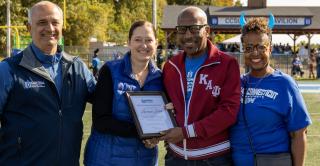
Central honors Larry Hall with Distinguished Service Award

Elementary Education, BS with Teacher Licensure (PK-6)
Total Credits Required: 120
As an Elementary Education major, you'll have the opportunity to build expertise in a subject area that interests you while meeting the Connecticut State Department of Education certification requirements. Selecting a content area major allows you to deepen your knowledge in a specific discipline and strengthens your preparation as a future educator.
Students will choose one of the following content areas:
As you explore a pathway into teaching, it is important to understand the difference between earning a degree from Central Connecticut State University and obtaining a teaching certificate from the State of Connecticut. While your degree provides the academic foundation for your career, certification is the credential required to teach in Connecticut’s public schools. Students pursuing a degree in education should also be aware of the subject-matter major requirement, which applies to all teacher candidates.
Secondary Education, BS with Teacher Licensure (Certifiable 4-12)
Total Credits Required: 120
Are you passionate about a particular subject and excited to inspire the next generation of learners? The Secondary Education program prepares future teachers to work with students in grades 4–12 by combining strong content knowledge with engaging teaching practices. Through coursework, field experiences, and student teaching, you'll develop the skills and confidence needed to create meaningful learning experiences and make a lasting impact in today's classrooms.
One of the first steps in your journey to becoming a certified teacher is selecting the subject area you are most passionate about teaching. Your content area major will align with the Connecticut State Department of Education certification requirements and prepare you to teach in your chosen discipline.
Choose one of the following content area majors:
As you explore a pathway into teaching, it is important to understand the difference between earning a degree from Central Connecticut State University and obtaining a teaching certificate from the State of Connecticut. While your degree provides the academic foundation for your career, certification is the credential required to teach in Connecticut’s public schools. Students pursuing a degree in education should also be aware of the subject-matter major requirement, which applies to all teacher candidates.
All-Level Education, BS with Teacher Licensure (Certifiable PK-12)
Total Credits Required: 120
If you're passionate about teaching a specialized subject or supporting diverse learners, an All-Level Education program may be the right fit for you. These programs prepare future educators to teach students from PreK through Grade 12, providing the knowledge, skills, and hands-on experiences needed to make an impact across a wide range of grade levels and learning environments.
At Central, All-Level Education certification pathways include Art, Music, Physical Education, Technology & Engineering Education, Dance and Special Education, allowing you to turn your passion into a rewarding career serving students throughout Connecticut.
As you explore a pathway into teaching, it is important to understand the difference between earning a degree from Central Connecticut State University and obtaining a teaching certificate from the State of Connecticut. While your degree provides the academic foundation for your career, certification is the credential required to teach in Connecticut’s public schools. Students pursuing a degree in education should also be aware of the subject-matter major requirement, which applies to all teacher candidates.
Graduates of the Bachelor of Science in Early Childhood Studies will be qualified to assume a variety of roles within the field of early childhood education and will be positioned well for continued studies in early childhood or related fields of study. Graduates will be eligible to apply for a LEVEL I (Infant Family Associate) Endorsement to the Connecticut Infant Mental Health Association (CT-AIMH), become an Early Childhood professional and a Quality Staff Member (Lead Teacher) in a state-funded early learning program, and will be positioned to enter graduate degree programs in early childhood or closely related fields. The program is intentionally aligned with the National Association for the Education of Young Children (NAEYC).
The Early Childhood Education program is aligned with the Professional Standards and Competencies for Early Childhood Educators, ensuring that teacher candidates develop the knowledge and skills needed to support young children's learning and development. Throughout the program, candidates build expertise in six core competency areas:
As part of the program, candidates complete a variety of supervised field experiences in diverse early childhood settings. Placements may include center-based, home-based, and comprehensive service programs, as well as public school classrooms. Candidates gain experience working with children across multiple developmental stages, including infants, toddlers, preschoolers, and kindergarten students, providing opportunities to apply coursework in authentic educational environments.