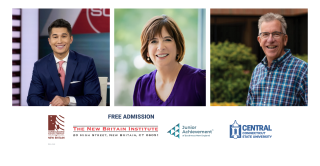
From startup to sports giant: ESPN panel to explore media innovation and impact
The American University of Madaba (AUM) can serve as the primary base camp host institution for U.S. study-abroad programs in Jordan. AUM’s “base camp” model provides U.S. institutions with a stable academic home base, while AUM coordinates the day-to-day local logistics required to deliver a high-quality international program. This structure allows visiting U.S. faculty to focus on academic content, student mentoring, and learning outcomes, while AUM manages operational details on the ground.
Jordan offers U.S. students a distinctive study-abroad experience that combines academic rigor, cultural immersion, hospitality, and safety. It is well suited for short-term, summer, and semester-long programs across a wide range of disciplines.
Jordan provides students with:
Jordan is also widely regarded as a safe and stable destination for international education. The U.S. Department of State assigns Jordan a Level 2 travel advisory, the same level applied to many popular European study-abroad destinations such as Italy, Germany, France, the United Kingdom, Spain, Sweden, and Denmark. This places Jordan well within the risk-management frameworks commonly used by U.S. study-abroad offices.
Together, these factors make Jordan an academically versatile, logistically efficient, welcoming, and secure location for U.S. study-abroad programs.
AUM can support visiting U.S. groups by coordinating key study-abroad logistics and campus-based resources, including:
This model creates a clear and efficient operational structure in which the U.S. institution does not need to independently manage local vendors, transportation, tickets, or daily logistics. As a result, faculty leaders and study-abroad offices can focus on academic delivery, student learning outcomes, and meaningful intercultural engagement.
Partnering with the American University of Madaba (AUM) as a study-abroad base camp offers U.S. institutions a significant reduction in administrative workload while strengthening academic structure, student supervision, and operational reliability.
Using AUM as the base camp allows U.S. study-abroad offices to avoid building and managing local infrastructure independently. This partnership:
Result: U.S. faculty can focus on teaching, student learning, and academic engagement, rather than managing daily travel and logistics.
AUM provides a stable academic home base with access to:
AUM's location enables organized and efficient travel to Jordan's most significant academic and cultural sites, including:
Together, these benefits make AUM a reliable academic partner that enables U.S. institutions to deliver high-impact, well-structured, and logistically manageable study-abroad programs in Jordan.
Jordan supports a wide range of academic disciplines and interdisciplinary learning themes, making it a highly adaptable study-abroad destination for U.S. institutions. Learning activities are closely connected to field-ready sites, living laboratories, and real-world contexts that enhance both theoretical and applied instruction.
Jordan provides strong opportunities to examine tourism economics, entrepreneurship, and regional trade. Field-based learning in Petra (UNESCO) and Jerash highlights cultural-heritage business models and destination management, while Amman offers insight into urban markets, startup ecosystems, public–private development, and cultural industries. Aqaba (Red Sea) supports applied study in logistics, trade gateways, port-adjacent economic development, and hospitality-sector strategy.
Jordan offers compelling environments for engineering and technology-focused programs. Petra (UNESCO) demonstrates ancient engineering innovation through advanced water systems, construction methods, and urban planning. The Dead Sea supports earth science and environmental engineering learning, while Amman provides exposure to smart-city concepts, digital infrastructure, and technology-driven institutions. Aqaba further supports applied learning in transportation systems, logistics operations, and infrastructure planning.
Jordan is a powerful setting for sustainability-focused education. The Dead Sea and Jordan Valley illustrate real-world challenges related to water scarcity and environmental change, while Dana Biosphere Reserve and Wadi Mujib support learning in conservation models, biodiversity, protected-area management, and eco-tourism sustainability. Wadi Rum (UNESCO) offers an exceptional environment for studying desert ecology, geology, climate adaptation, and sustainable tourism planning.
Jordan supports experiential learning in health, wellness, and public health. The Dead Sea connects environmental health, wellness tourism, and mineral-based therapeutic industries. Dana Biosphere Reserve and Wadi Mujib offer outdoor learning tied to wellbeing and public health awareness, while Amman provides opportunities to observe healthcare delivery models, community wellbeing initiatives, and health-service infrastructure.
Jordan offers rich settings for language learning, intercultural communication, and cultural studies. Madaba and Mount Nebo support studies in cultural heritage, religious traditions, and historical mapping. Bethany Beyond the Jordan (UNESCO) provides context for interfaith heritage and cultural diplomacy, while Amman Citadel and the Roman Theater illustrate multi-civilizational history and contemporary cultural identity. Additional sites—including Ajloun, Karak, and Shobak Castles, Desert Castles such as Qasr Amra (UNESCO), and Wadi Rum (UNESCO)—support learning in medieval history, geopolitics, anthropology, and experiential intercultural engagement.
Together, these academic themes demonstrate how Jordan enables high-impact, field-based, and interdisciplinary learning, making it an effective and flexible destination for U
Jordan's archaeological, cultural, natural, and urban sites function as integrated learning environments - or living laboratories-that support rigorous academic instruction, hands-on fieldwork, experiential learning, and peacebuilding education across a wide range of disciplines, including Business, Engineering, and STEM fields. These sites allow students to connect classroom theory with place-based evidence, real-world systems, and social contexts, while also examining how societies sustain stability, dialogue, and cooperation in a complex regional environment.
Primary Fields: Engineering, Architecture, Urban Planning, Business, Economics, Sustainability, Heritage Studies, STEM, Peacebuilding
Petra provides one of the most comprehensive field laboratories in the world for engineering, applied STEM learning, and urban systems analysis. Students study Nabatean water-resource engineering, including channels, cisterns, dams, and pressure systems, gaining insight into sustainable infrastructure design, hydraulic engineering, and systems thinking in arid environments. Architecture and urban planning students examine rock-cut construction, spatial organization, and environmental adaptation.
From a business, economics, and entrepreneurship perspective, Petra illustrates how trade networks, geographic positioning, infrastructure investment, and institutional organization supported regional commerce linking Arabia, the Levant, and the Mediterranean. Courses in tourism economics, heritage management, and sustainable business models analyze Petra as a modern cultural-tourism economy balancing preservation, local livelihoods, and global demand.
From a peacebuilding lens, Petra demonstrates how commerce, shared economic incentives, and cultural exchange historically fostered cooperation across regions—an enduring lesson for economic diplomacy, conflict resolution, and regional stability studies.
Primary Fields: Geology, Environmental Science, Anthropology, Sustainability, STEM, Peace Studies
Wadi Rum supports field-based STEM learning in geology, geomorphology, earth systems, and climate adaptation, allowing students to study desert ecosystems, rock formations, and long-term environmental change. Environmental science and sustainability students explore fragile ecosystems, conservation strategies, and climate resilience in arid landscapes.
Anthropology and cultural studies programs engage with Bedouin heritage, oral traditions, and indigenous knowledge systems, examining how traditional livelihoods adapt to environmental constraints.
From a peacebuilding and development perspective, Wadi Rum offers a strong case study in community-based eco-tourism and sustainable enterprise, illustrating how conservation, local participation, and economic opportunity contribute to social cohesion, livelihoods, and long-term stability.
Primary Fields: Environmental Science, Chemistry, Public Health, Economics, Sustainability, STEM, Peacebuilding
The Dead Sea is a unique natural laboratory for STEM-based learning in geology, chemistry, mineral systems, and environmental science, with its extreme salinity supporting study of evaporation processes, earth-system dynamics, and industrial resource extraction.
Public health, wellness, and health-economics programs analyze the Dead Sea's role in therapeutic tourism, linking environmental conditions to health outcomes, medical services, and regional economic development.
From a policy and peacebuilding perspective, the Dead Sea region highlights shared environmental and economic challenges that transcend borders. Students explore environmental peacebuilding, water diplomacy, and cooperative resource governance as essential tools for regional stability.
Primary Fields: Public Policy, International Relations, Business, Economics, Sociology, Urban Studies, STEM, Peacebuilding
Amman serves as a living classroom for understanding modern governance, economic development, entrepreneurship, and urban transformation. Students engage with ministries, universities, markets, NGOs, startups, and cultural institutions to study public administration, economic policy, service delivery, innovation ecosystems, and civic engagement.
Urban studies, sociology, and data-driven STEM programs examine migration, infrastructure growth, smart-city concepts, and social resilience. Business and entrepreneurship students explore startup ecosystems, public–private partnerships, financial systems, and innovation policy.
From a peacebuilding perspective, Amman illustrates how institutional capacity, inclusive governance, and social services support resilience in a region affected by conflict. Students analyze how diplomacy, moderation, and civic institutions contribute to long-term peace.
Primary Fields: History, Archaeology, Political Science, Architecture, Cultural Studies, Engineering
Jerash provides an open-air classroom for Roman urban planning, civic engineering, and infrastructure systems, allowing students to study how roads, theaters, water systems, and public spaces supported political authority, trade, and social life.
The Amman Citadel offers a multi-civilizational systems perspective, supporting studies in strategic geography, settlement patterns, governance, and infrastructure continuity.
These sites also enable peace-focused discussion on shared heritage, cultural continuity, and preservation as tools for dialogue, identity, and reconciliation.
Primary Fields: Religious Studies, Cultural Diplomacy, History, Communication, Peace Studies
Madaba's mosaics and the Madaba Map support learning in art history, early cartography, geographic representation, and communication systems.
Mount Nebo and Bethany Beyond the Jordan provide globally significant contexts for interfaith dialogue, pilgrimage studies, cultural diplomacy, and peacebuilding, illustrating how shared sacred spaces foster mutual understanding and peaceful coexistence.
Primary Fields: Medieval History, Geopolitics, Military Engineering, Governance
Jordan's castles illustrate medieval power dynamics, military engineering, and strategic geography, supporting learning in geopolitics, defense systems, and conflict studies.
The Desert Castles, including Qasr Amra (UNESCO), support study of early Islamic governance, applied architecture, art, mobility, and cultural exchange, showing how administration and cultural expression evolved following periods of conflict.
Primary Fields: Environmental Studies, Sustainability, Leadership, STEM, Development
Dana supports experiential learning in biodiversity conservation, sustainability economics, eco-tourism business models, and environmental policy, demonstrating how environmental stewardship supports community livelihoods and development.
Wadi Mujib offers field-based learning related to risk management, environmental systems analysis, leadership development, and team dynamics, reinforcing how natural environments contribute to resilience and problem-solving.
Primary Fields: Marine Science, Logistics, Trade, Engineering, Environmental Policy, Peacebuilding
Aqaba provides applied STEM and business learning in marine ecology, port logistics, transportation systems, tourism development, and international trade, illustrating how economic growth and environmental protection can coexist.
The Jordan Valley serves as a case study in water scarcity, agriculture systems, climate adaptation, engineering solutions, and regional cooperation, reinforcing the importance of shared-resource governance in peacebuilding.
Across these sites, Jordan enables deeply integrated, place-based learning that connects Business, Engineering, STEM, and the social sciences to real-world challenges. Students gain not only disciplinary knowledge, but also a grounded understanding of sustainability, innovation, governance, cultural exchange, and peacebuilding as lived practices embedded in landscapes, institutions, and communities.
Jordan's sites therefore support high-impact, experiential education that prepares students for STEM careers, business leadership, public service, global citizenship, and constructive engagement in an interconnected world.
Program cost depends on several factors, including program length, number of excursions, academic activities, and travel itinerary. Rather than offering a fixed price, AUM works collaboratively with U.S. institutions and faculty leaders to design programs that are academically strong, logistically sound, and financially accessible to students.
As a planning benchmark, AUM's objective is to help structure programs so that total student cost does not exceed approximately $3,500, including round-trip airfare from major U.S. gateways such as JFK, whenever feasible. Final costs vary depending on institutional preferences, timing, and program design.
To help keep costs affordable for U.S. students, AUM will make its best effort to secure local support and sponsorships within Jordan that may reduce out-of-pocket expenses. Where possible, this may include:
These cost-reduction efforts are pursued subject to availability and partner participation and are intended to improve student affordability rather than generate revenue.
Importantly, this program model is not designed as a profit-driven activity for AUM. Supporting international study-abroad programs aligns directly with AUM's academic mission and strategic plan, which emphasizes global engagement, intercultural learning, and international academic cooperation. AUM's role is to reduce logistical and administrative barriers and help U.S. institutions deliver high-impact global learning experiences.
AUM works closely with faculty leaders and study-abroad offices to:
The result is a financially viable, academically rigorous, and mission-aligned program that prioritizes student learning, access, and global engagement.
The American University of Madaba (AUM) follows an academic calendar that is broadly compatible with U.S. semester schedules, and it also offers flexibility to support short-term, faculty-led, and custom study-abroad programs. The official AUM academic calendar is publicly available and updated for each year — including semester start and end dates, breaks, and exam periods — and can be viewed on AUM's website:
For faculty-led programs, AUM works directly with partnering U.S. institutions to align academic schedules, ensuring that program dates do not conflict with home-institution commitments. This flexibility allows visiting groups to tailor programs to fit:
AUM's academic calendar provides a structured framework for curriculum planning while still allowing flexibility for customized program schedules.
Please email: Musabe@musabe.org
Recommended subject line:
The American University of Madaba (AUM) – Base Camp Inquiry
A member of the AUM international team will follow up to discuss academic alignment, scheduling, and program design.
To help us respond efficiently, please include the following information in your email:
Providing this information allows the AUM team to assess feasibility and propose program options that align with your academic objectives and student needs.