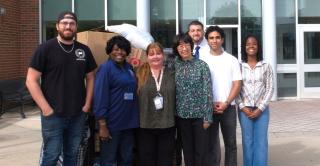
Fresh fashions fill Career Closet

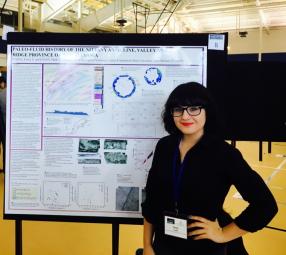
Emily Gajda Earth Sciences URCAD presentation Fall 2016
This year’s URCAD will take place on Friday, May 8th and will feature research, scholarship, and creative work carried out by Central undergraduate and graduate students. There are no restrictions to student class rank or academic discipline for these sessions. Students will have the option to present their work in either a poster or oral presentation format.
Broadening the Notion of Creative Achievement
This year, URCAD plans to broaden the notion of creative achievement and invite applicants to showcase projects from a wider array of disciplines. As such, presentations outlining supervised student work in the following areas are welcomed:
Traditional Empirical Research
Creative Achievement
In addition, "Reverse Job Interviews" will be featured at this year's URCAD event. This innovative idea brought forth the CLASS Board of Advisors will feature students presenting their research and projects from a variety of different disciplines in an oral presentation to community partners. These community partners will then share perspectives and opinions on how they think the idea could be utilized in the public sector to affect change for people. In this way, the creative achievement of researchers, creators, executives, and policy makers can be witnessed in real time with fascination discussions to follow.
Poster Presentations
Students will have the option to show their work in the form of a poster presentation which typically consists of a series of figures or tables that tell a story minimal text.
Oral Presentation
Students will have the option to present their work in the form of an oral presentation. Generally, oral presentations consist of a slide show that describes the background, methodology, results/discussion, and conclusions of the student's project.
Duration: Students should prepare for a 10-minute presentation, immediately followed by a 5-minute Q&A session with the audience.
Students should adhere to the guidelines relevant to their area of study when designing their oral presentation.
Oral presentation slide shows should be prepared using Microsoft Power Point and saved to their OneDrive for easy access at the day of the event.
Demonstrations
Demonstrations can be compared to an interactive "show-and-tell" activity, where the presenter goes through the process of generating a finished, original product. Such presentations may include the following elements: Real-time action, physical models, or software demo. The components of a student's demonstration will ultimately be determined by what is customary in their field of study.
Students will be allotted a 15-minute time block to present a demonstration of their creative activity and address questions from the audience.
How to propose an URCAD Poster or Oral Presentation?
Students interested in presenting at URCAD should complete the appropriate form located at "Propose an URCAD Presentation". The form provides an option to indicate the preferred presentation format (poster, oral, or demonstration). There are separate forms for undergraduate- and graduate-level presentations.
A completed poster or slide show is not required at the time of proposing an URCAD presentation.
Note: Students participating in "Reverse Job Interviews" do not need to submit an URCAD Presentation Proposal as CLASS has their own procedures in place.
Please contact Dr. Jason F. Sikorski, Associate Professor of Psychological Science at CCSU, with any questions about applications, abstract submission or presentations.