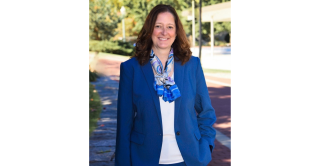
Dr. Kimberly T. Kostelis appointed interim president

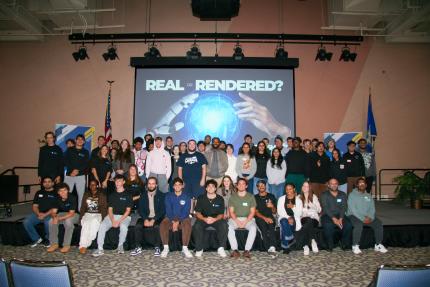
In October 2025, the Artificial Intelligence and Information Systems Club hosted “Real or Rendered?”, a live spin-off of the classic Turing Test, bringing in over 60 attendees to Alumni Hall. Contestants lined up single-file and were shown questions on-screen alongside answers either written by humans or generated by a variety of AI chatbots — including ChatGPT, Claude, Grok, and others — then had to physically step left if they believed the response was “rendered” by AI, or right they believed it was written by a “real” human. With each round, the group thinned until a winner was crowned, with the top 5 remaining contestants each walking away with a prize sponsored by the Information Technology Department. The event was a lively and engaging way to bring AI literacy to life and challenge attendees to think critically about the line between human and machine.
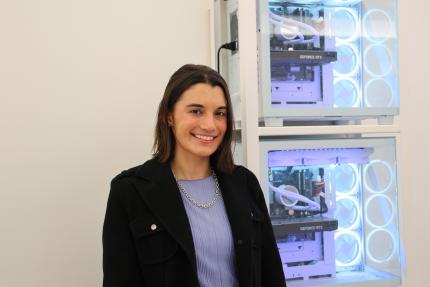
Sadie Simek is a dual-enrolled undergraduate and master’s student in Cybersecurity at Central, President of the Women in Cybersecurity Club, and a former student worker in the Information Technology (IT) Department as an On-Site Support Technician. When the IT Department provided her with a dedicated research space and an NVIDIA DGX Spark desktop computer, it transformed her AI research from a slow grind on a personal laptop into a full-scale academic endeavor, cutting model processing time from weeks down to overnight runs and enabling her to benchmark 131 large language models in four months. Her research, advised by Dr. Ramyapandian “Ramya” Vijayakanthan, investigates why locally-hosted AI models produce inconsistent outputs even when given identical prompts. This concept, known as “AI model instability,” is an emerging and understudied problem in AI security. Their efforts have since grown, with additional devices and students joining the project. Most recently, the team’s paper was accepted for presentation at the 2nd Annual CAIA Research Symposium at the Hartford AI Conference, where they will present alongside speakers from Google and IBM, while also pursuing publication at ACM CCS, a conference with a 9%-19% acceptance rate. As Sadie noted, “We could not have hit this milestone without the momentum you helped generate by providing a research space and the extra technology.”