Dr. Kimberly T. Kostelis appointed interim president


Master of Science in Artificial Intelligence (AI)
Minor in the Application of Artificial Intelligence (AI)
The AI Corridor is truly interdisciplinary, bringing together expertise from across fields such as computer science, data analytics, engineering, business, healthcare, and more. Its unique governance structure is provided by the Presidential Taskforce on Artificial Intelligence, established by Central's President Zulma Toro in 2024, to ensure that the corridor evolves alongside the rapid advancements in AI and aligns with the university's strategic vision.
The Interdisciplinary AI Committee has produced a preliminary curriculum document.
Download the Preliminary Curriculum Document
Impacting Education, Vol. 10 No. 1 (2025): The Role of Generative Artificial Intelligence (AI) in Doctoral Research and Writing.
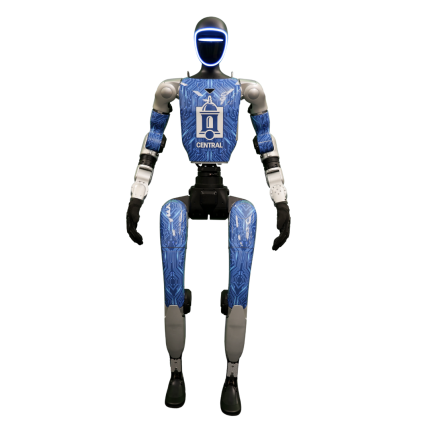
Shortly before the start of the Spring 2026 semester, the university acquired a Unitree G1 robot. The G1 is a humanoid robot that is about the size of a child. It stands approximately 52 inches tall, weighs almost 80 pounds, and has 43 degrees of freedom of movement across its joints (Unitree, 2026). This level of freedom lets the robot move and perform tasks like a human. This will allow for research into the industrial applications of humanoid robots.
The G1 expands the university’s investment in robotics as it is significantly more advanced than the Go2 robot, which was acquired in 2024. Both the Go2 and G1 utilize the same development environment. They use ROS2 (robotic operating system 2) and a Unitree SDK (software development kit) for the C and Python languages. This shared platform allows faculty and students to transition the skills learned on the Go2 to the G1.
The versions of the robots that university purchased are for use in education and research and have been used for academic works, including training the G1 to perform human-like motion (https://arxiv.org/pdf/2502.01143). Both the G1 and Go2 have attached Nvidia Jetson computers used for secondary development and enhanced Lidar for improved navigation. The G1 has two sets of hands, a mannequin set for demonstration, and the Inspire dexterous hands which are used for manipulations. These hands have six degrees of freedom and 12 joints, which mirror those of human hands.
With the addition of the G1, the university is well positioned to educate our students in the combined areas of AI and robotics. This is an area of development that will likely see a large amount of growth over the next several years as both humanoid and non-humanoid, autonomous, AI powered robots are integrated into manufacturing, logistics, and supply chains.