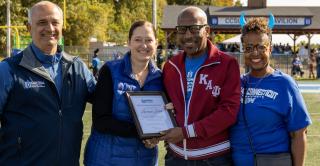
Central honors Admissions Director Larry Hall with Distinguished Service Award

Dear Central Family,
I am writing to share an exciting and important conversation about Central Connecticut State University’s future.
As the higher education landscape continues to evolve, institutions across the country are reimagining how they serve students, employers, and communities. At Central, we are exploring the opportunity to further define ourselves through a research 2 polytechnic model—one that intentionally integrates applied and experiential learning, research, innovation, and our strong liberal arts and social sciences foundation.
Let me be clear: This will be a deliberate and inclusive planning process, and we want everyone to be involved. The work ahead will benefit from the expertise, insight, and engagement of our faculty, staff, students, alumni, and partners.
Central is uniquely positioned for this moment. In addition to the liberal arts and social sciences, our academic strengths span engineering, applied sciences, cybersecurity, artificial intelligence, robotics, health sciences, and education, complemented by deep interdisciplinary collaboration and a commitment to student success. We also hold distinctive designations, including national recognition in cybersecurity and our status as an Age-Friendly University, reflecting innovation and inclusivity.
Equally important is how learning happens at Central. Through applied learning — embedded in curricula, industry partnerships, and experiential opportunities — we are building pathways that connect classroom knowledge to real-world impact. Our Central Applied Learning and Industry Corridor, workforce and innovation initiatives, and community partnerships are designed to bring students, faculty, employers, and communities together in meaningful ways. Our goal is for every graduate to leave Central with at least two applied and experiential learning opportunities that prepare them for careers, graduate study, and civic leadership.
Our vision also includes clusters of excellence in areas such as Industry 4.0, cybersecurity and artificial intelligence, global health, climate and ecological resiliency, transformational models in education; and economic inequality, supported by state-of-the-art facilities. At the same time, Central remains deeply engaged locally and globally, strengthening connections across Connecticut and around the world.
A polytechnic designation would require approval by the Connecticut State Colleges and Universities (CSCU) Board of Regents and, ultimately, consideration by the State of Connecticut. To prepare for this process, I have established eight task forces, including a steering committee, charged with developing a comprehensive, evidence-based assessment of Central’s readiness to pursue this designation and a roadmap to achieve it. Timelines for this work will be shared as they are finalized.
A polytechnic model offers an opportunity to amplify what we already do well: combine theory and practice, expand research with impact, deepen industry and community partnerships, and prepare graduates who are ready to lead in a rapidly changing world.
In the weeks and months ahead, we will host open forums and engagement opportunities so that students, faculty, staff, alumni, and community partners can learn more, ask questions, and share perspectives. A web page dedicated to this initiative is in development, and we will share the URL with you as soon as possible. The web page will be updated regularly as we progress on this journey.
The future is Central — and it will be built together.
Sincerely,
Zulma R. Toro
President