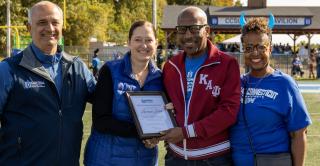
Central honors Admissions Director Larry Hall with Distinguished Service Award

The principles guiding the exploration process at Central for the Development of a Research 2 Polytechnic Investment Case are transparency, accuracy, and collaboration. To that end leadership has gathered frequently asked questions and answered them based on the campus open forums where the president launched this process for Central.
Right now, we are exploring both our existing strengths and new possibilities to inform a proposal or case for investment. Part of the process includes understanding the characteristics of a comprehensive polytechnic and inviting students, faculty, staff, and community stakeholders to join this exploration or contribute. Our goal is to build upon Central’s unique strengths and educational foundation to make a collective case for state investment in Central as a polytechnic university.
Being responsive to the educational requirements of a changing society, state, and region demands Central establish a future-friendly, comprehensive, and applied educational approach building on our existing strengths. If Central becomes a polytechnic institution, our degree programs gain value in a few ways: experiential learning and applied research across all programs will engender more direct job readiness among our graduates. Central’s commitment to the liberal arts and sciences will ensure that graduates of any academic program emerge as good communicators, ethical analysts, creators, and nimble critical thinkers in a variety of complex work environments. This process will also allow for the development of unique, multidisciplinary degree programs integrating liberal arts, sciences, and technology. As such, Central graduates would be well-positioned to fill critical needs in the professional workforce.
Central will continue to be a comprehensive university. We are not losing our identity but expanding it. In essence, Central will place greater emphasis on student success by providing more opportunities for students to take what they learn in the classroom and apply it to real-world problems. Central will strategically work with industry and community partners to create more internships, externships, and research opportunities that will enhance our students’ ability to apply knowledge in a meaningful way across multiple disciplines. These partnerships also help create clearer, more defined, pathways from education to employment for students in all majors, not just those in STEM-related programs. Ultimately, becoming a comprehensive polytechnic university is a natural next step for Central and doing so provides a vehicle to expand our impact as a driver of social mobility for its students.
No. However, all the established strengths across Central’s vast academic offerings combined with nationally recognized programs and designations create an opportunity for further state investment and an elevated academic profile in the state and nation.
Absolutely – there is no single definition of a polytechnic university. At Central, we will maintain and enhance our commitment to liberal arts and social science programs. These essential disciplines prepare students to be strong, critical thinkers, communicators, and collaborators. Integrating these skills into hands-on learning experiences prepares students to navigate the complex social, professional, and political realities of today’s rapidly changing world. With the speed of change accelerating, individuals who possess these skills will find they are nimble and agile practitioners who are uniquely prepared to succeed within their field(s) of study.
This is why Central remains committed to the liberal arts and social science foundation embedded in our general education program and the majors and minors currently offered within Carol A. Ammon College of Liberal Arts and Social Sciences (CLASS). It is also why we are actively working to develop new, interdisciplinary majors and minors, that combine the strengths of the liberal arts and social sciences with topics that are traditionally taught in the other schools/colleges on campus.
A comprehensive polytechnic university prepares students to be lifelong learners who think critically about a variety of topics. Even if a student did not major in a specific area, the skills taught at a comprehensive polytechnic prepare graduates to be nimble and agile thinkers who can quickly adapt to the ever-changing global landscape. A vocational school teaches only the skills required for a specific job.
Central already emphasizes:
Together, these elements create a solid foundation for a next-generation polytechnic approach.
As a Comprehensive Polytechnic, students will complete their bachelor’s degree requirements at Central ready to excel in their field(s) of interest. All students will work hand-in-hand with our industry and community partners by participating in experiential/applied learning that prepares them to put the theory learned in the classroom to use in real-world situations. Through these opportunities, students distinguish themselves from their peers by gaining direct experience in their field while developing first-hand understanding and appreciation of the subject matter.
In other words, students will leave Central as skilled practitioners who have already taken their first steps as professionals. This enhanced experience is reflected in the earnings of graduates. National studies show that students who participate in experiential learning earn significantly higher starting salaries and continue to out-earn their peers throughout their working career (yes, even 20+ years after graduation). Additionally, students enter their next phase – be it the workforce, graduate school, or volunteering – better prepared to demonstrate not only what they have learned in the classroom but also showcase their essential skills such as critical thinking, effective communication, and working collaboratively within a team.
The student academic experience will continue to be grounded in the liberal arts and social sciences. Central remains committed to providing a wide variety of student clubs, activities, and organizations and will continue to compete in Division I NCAA athletics. Becoming a polytechnic university is an enhancement, and, at least for Central one that is focused on enhancing student success through applied learning. We are committed to providing more opportunities for students to engage in internships, research with their professors, and work with employers to solve the real-world problems of today. Students will also have more opportunities to study abroad to experience the diversity of cultures and experiences that exist in today’s connected society.
There is no reason to believe our athletic NCAA Division 1 status will change.
No and No. First, tuition is set by the Board of Regents; there are currently no plans to change the tuition or fee structure. Second, Central will continue to strive to be the most affordable university in the state with a focus on serving the citizens of Connecticut and its first-generation students.
While the task force process continues to explore this idea, Central’s current admission policy of accepting students year-round will continue. A state law that allows Connecticut high school seniors with grade point averages at or above 3.0 (weighted), which includes AP and Honors courses, or a GPA of 2.75 (unweighted) to receive automatic admission to Central and any school in the CSCU system will remain active. It is important to note that Central will maintain its commitment to inclusion in admissions.
A number of Polytech universities follow a two-semester academic calendar. But some do expand the academic calendar and provide three semesters.
Central plans to remain true to its mission and provide access to a high-quality education to the citizens of Connecticut. Within the region, Central is well-regarded and we often hear that Central graduates outperform their peers throughout their career. Working more closely with industry and community partners and increasing the breadth and depth of experiential/applied learning available to students will further enhance the reputation of the University and its students.
Becoming a comprehensive polytechnic university will also facilitate new partnerships between the university and its regional industry and community partners. These partnerships will span all majors and fields of study and provide increased opportunities for students to engage in experiential/applied learning. By working closely with our students and our partners, Central will continue to adapt to the changing needs of the state and the region, offering degree programs that prepare students for the careers of today and tomorrow.
No. Central is in the exploration phase of a self-study process. Task forces and steering committees are studying academic programs, infrastructure, applied and experiential learning, partnerships, and financial sustainability. Broad campus and community input is a core part of the process. The university will submit the final plan to the Board of Regents at the end of the summer and then, if approved, the CSCU System Chancellor and the president will present the plan to the General Assembly for consideration in February of 2027. The state has its own process of passing legislation through multiple layers of committees of cognizance, through the State House of Representatives, and State Senate, then ultimately the Governor.
Attend open forums, share feedback, participate in discussions, and engage with your department or division as more opportunities to participate in the process are announced.
Explore the webpage dedicated to the process of Exploring a Research 2 Polytechnic University Designation where you will find the latest meeting dates, agendas, and notes from the work by the task forces. There is also a link to submit questions and/or feedback.