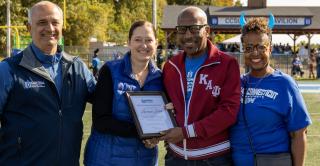
Central honors Admissions Director Larry Hall with Distinguished Service Award

H-1B status allows international employees in specialty occupations to work in the United States for a sponsoring employer for up to six years. At Central Connecticut State University, the Office of International Student & Scholar Services (ISSS) prepares and submits H-1B petitions for eligible university employees and serves as the university’s designated office for visa sponsorship and compliance. Outside attorneys may not file H-1B petitions on behalf of Central.
The Office of International Student & Scholar Services provides administrative support for university sponsored immigration petitions and does not offer legal advice, legal representation, or assistance with personal immigration matters, including dependent applications. Individuals seeking assistance with these matters should consult a qualified immigration attorney.
Eligibility & Sponsorship
To be eligible for H-1B sponsorship at Central, international faculty must:
Individuals who are ABD (All But Dissertation) are not eligible for H-1B sponsorship and should pursue Optional Practical Training (OPT) through their current institution.
Individuals subject to the J-1 two year home country physical presence requirement (INA 212(e)) must obtain a waiver before H-1B sponsorship can be pursued.
Central covers the required filing fees associated with H-1B sponsorship for eligible employees.
Petitions & Extension
Processing times vary based on internal university procedures and government processing times.
Human Resources and Academic Departments should allow a minimum of three months for the sponsorship process and are encouraged to begin as early as possible.
The petition process cannot begin until all required employee documents have been received by ISSS. Delays in submitting requested documentation may significantly extend processing timelines.
An initial H-1B petition is for an individual who is not currently in H-1B status. An H-1B transfer is for an individual who already holds H-1B status and is changing employers. To transfer H-1B status to Central, ISSS must file a new petition with USCIS before employment begins.
Human Resources and Academic Departments are responsible for initiating the extension process. Employees should contact ISSS at least six months before their H-1B expires to allow enough time to prepare and file the extension request.
A timely filed H-1B extension allows you to continue working at Central for up to 240 days while USCIS reviews your petition, or until a decision is issued.
Maintaining Status
Maintaining your H-1B status is your responsibility. To remain in lawful status, you must:
Failure to maintain your H-1B status may result in a loss of lawful immigration status and employment authorization.
Travel
Yes. If you are entering the United States in H-1B status for the first time, you may arrive up to 10 days before the start date listed on your Form I-797 Approval Notice and up to 10 days after your H-1B expires. However, this is at the discretion of the immigration officer at the point of entry. You may not begin working until the start date authorized on your H-1B petition.
Contact ISSS before traveling internationally if you have questions about your travel documents.
No. However, employees who are applying outside of the United States must obtain a H-1B visa before entry into the United States.
You must be physically present in the United States when your H-1B extension petition is filed. It is not advised to travel while your H-1B extension is pending.
Employment Changes
Your H-1B status is based on your employment at Central. When your employment ends, you are generally expected to depart the United States unless you are eligible to remain in another lawful immigration status.
If your employment ends before your H-1B petition expires, you may qualify for a grace period of up to 60 days or until your H-1B end date, whichever comes first.
During this time, you may:
The 60-day grace period is granted at the discretion of the U.S. Department of Homeland Security (DHS) and is not guaranteed. You may not work during this period unless otherwise authorized.