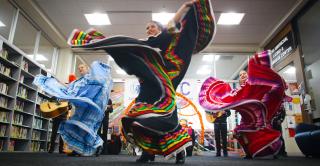
Central alum premieres documentary at Woodstock Film Festival

Greece has always been a place where big ideas take root, and where you can still walk among them. This course pairs on-campus study with a journey to Greece in May, tracing how one of the world's oldest civilizations became part of the modern global economy.
The course explores how the decisions of ancient city-states, medieval traders, and twenty-first century finance ministers have shaped a country and, through it, the world. Along the way, students examine questions of governance, trade, debt, and development that are as urgent today as they were in ancient times.
Athens itself then becomes the classroom. At the Agora, you'll stand where citizens once debated, traded, and built the first democratic institutions. At the Pnyx, the hillside where Athenians voted, the idea of collective decision-making stops being abstract. The Acropolis and its museum reveal how culture, power, and wealth have always been intertwined.
Greece's experience at the center of the 2010 sovereign debt crisis, one of the most closely watched economic events of the modern era, offers a case study in how global finance, austerity, and international institutions shape everyday life. At Piraeus, one of the Mediterranean's busiest ports, you'll see how Greece's position in global trade has barely changed in three thousand years.
A trip to the nearby island of Aegina trades the city's energy for turquoise water, pistachio farms, hillside villages, and a 5th-century temple that has overlooked the Saronic Gulf for two and a half thousand years. Students will also connect with a local organization, putting course ideas to work in a real community context.
Open to students from any major, this course offers something harder to find in a classroom: the chance to see economics come alive in one of the world's most storied places.