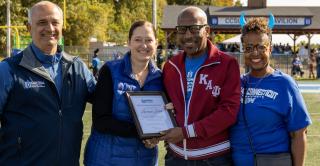
Central honors Admissions Director Larry Hall with Distinguished Service Award


A contributor to Worldwide Climate Justice & Education Month
Thursday, April 9, 2026 | Student Center – Alumni Hall
FREE & OPEN TO THE PUBLIC
Join us as we examine challenges facing society regarding climate change.
If you would like to have an exhibitor’s table, please contact Dr. Charles Button by email at Buttonche@ccsu.edu or by phone: 860.832.2788.
The Central Connecticut State University Global Environmental Sustainability Action Coalition (GESAC) invites you to learn and teach about the actions humans must take now to ensure that future generations will experience a life of peace, health, and harmony with our one and only home -EARTH.
Click here for directions to Central and campus map
| 10:00 – 10:30 | Welcome & Opening AddressDr. Charles E. Button, Professor - Central Geography Department & GESAC Founder & Chair |
| 11:00 – 11:45 | Planting Seeds: The Notable Presence of Trees in Non-Nature-Focused CoursesModerator: Leah Glaser, Ph.D., Central Presenters: Alina Gross, Ph.D., Westfield State University Trees have value as green infrastructure design elements that have potential to fight climate change by absorbing carbon dioxide or being tools for combating air pollution. Trees have cultural value as well, providing comfort, personal identity and a home.. This presentation is aimed at sharing with the audience our own experiences of how the mention of trees has come into our classes, particularly in courses that were not explicitly focused on nature. With examples of how discussions took place in our classes that brought about trees, assignments that produced insightful reflections on trees, and additional examples, we want to share the value of trees established by our students, sometimes confirming what we already believed, and sometimes in ways that we were not anticipating. |
| 12:00 – 12:45 | Maintaining Healthy Forest Ecosystems - Perspective from 50 years ExperienceModerator: Cassandra Forsythe, PhD., Central Presenter: Peter Forsythe, Retired Silvicuture Forester; Owner, Huckleberry Forestry Ltd. A proud member of the Canadian Institute of Forestry Ecosystems are integrated systems of abiotic elements—soil, rainfall, aspect, climate—and biotic components like plants, animals, and microbes. Differences among ecosystems arise from variation in those abiotic factors and from the specific requirements of organisms: plants need suitable soils, water, light and temperature to germinate and grow, while animals need food, shelter and reproductive sites with connectivity for movement. Human management offers benefits—restoring degraded habitats, controlling invasives, protecting services and reducing risk—but also costs: unintended impacts, expenses, dependence on ongoing intervention, and potential disruption of natural dynamics. Leaving ecosystems to self-manage can foster resilience, lower costs and re-stablish natural processes, yet recovery may be slow and vulnerable to invasions or loss of valued species. In this presentation, we will explore best practices for maintaining ecosystems such as intervening minimally but decisively when thresholds of irreversible loss or critical service failure are threatened. Harvesting should follow sustainable limits based on regeneration and carrying capacity. Restoration favors native, structurally diverse plantings and passive regeneration when seed sources and soils remain; natural ground cover and shrubs aid erosion control and habitat complexity. Maintenance involves allowing nature to choose what thrives or dies, and determining types of treatments—mechanical, chemical, biological, ecological—to match objectives with a careful lens on intensity. We will finally explore how to improve our management skills with training, interdisciplinary teams, and community engagement, and determine if we have actually moved forward over the past several decades or if we still have a far way to go. |
| 1:00 – 1:45 | Panel – The Forest and the Trees: Representations of Trees in the Literary CanonModerator: Charles E. Button, Ph.D., Central Panelists: Playwright John Heywood’s 1546 adage, “can’t see the forest for the trees” is often used to criticize someone who is narrow-sighted, someone who spends so much time looking at a particular detail that she misses the larger context. Such a criticism is often used against literary studies itself, a discipline so focused on the skill of explication or close reading that the larger literary context gets missed. This panel seeks to correct that misperception by showing how a close reading of literary representations of trees throughout the literary canon—from the medievalists to the moderns—helps bring us back to the larger picture: a value for, and worry about, the future of trees and forests, and humans’ ability to sustain them. |
| 2:00 – 2:45 | Flowering Cherry Tree Armenian Circle Dance (Participatory Dance Performance)Performer: Leanne Zalewski, Ph.D., Central The Flowering Cherry Tree Armenian Circle dance was historically performed in nature by community members. Many of these folk dances, once so prevalent and a way of bringing people together, are rapidly disappearing. Dr. Zalewski will lead participants in a 30 minute group performance, beginning with a brief introduction, the majority to teach the movements to anyone interested in participating, and then the circle dance itself, which is less than four minutes. Ideally this will take place outside among trees on campus, weather permitting. |
| 3:00 – 3:45 | Poster PresentationsStudents and faculty across disciplines will present posters relevant to trees, sustainability, and/or climate change. |
| 3:00 – 4:45 | Sustainability Exhibitors Exchange (list of exhibitors provided below)with Jazz Music provided by Brown Paper Sax Interact with sustainability vendors, enthusiasts from non-governmental organizations, businesses, and governmental agencies that offer sustainability information, jobs/internships, and services to society while you and enjoy the sweet jazz stylings of Brown Paper Sax. |
| 4:00 – 4:45 | What is Art that BreathesModerator: Sonja Czekalski, Central Connecticut State University Presenter: Tonya Lemos Art that Breathes is an ongoing, process-based inquiry into art-making as a living, reciprocal relationship with the natural world. In this talk, artist and herbalist Tonya Lemos explores how creative practice can become an act of ecological remembrance and devotion; one that honors impermanence, reciprocity, and the wisdom of materials. Drawing from her interdisciplinary work with plants, natural pigments, and book arts, Lemos invites us to consider art not as a product but as process, ritual, and conversation with the more-than-human world. |
| 5:00 – 6:00 | Tangled Roots: Echoes of HerStory in Environmental Justice Art Exhibition (taking pace in the Chen Art Gallery)In Tangled Roots: Echoes to of Her Story in Environmental Justice the exhibiting artists use visual media to demonstrate the inextricable tie of nature’s connection to humanity including its practice of oppression on women and the environment, tying herstory and gender oppression directly tied with the voice of the climate crisis. This exhibition brings together intergenerational artists working across various media to explore the intersections of art, activism, and the environment. Through painting, sculpture, textiles, photography, and digital media, the exhibiting artists use remnants of visual culture to transcend materials into sustainable practice and artistic advocacy. Like the growth rings in a tree, the intergenerational works in this exhibition reflect the reverberating voices across decades, demanding to be heard before it is too late. By fostering an interdisciplinary and intergenerational exhibition examining climate and gender activism, this collection of work underscores the urgent need for change while celebrating and giving voice to the resiliency of those fighting for a sustainable and just future. Sustainability Exhibitors |
If your organization, governmental agency, or business wishes to have an exhibit, email Dr. Charles Button: Buttonche@CCSU.edu