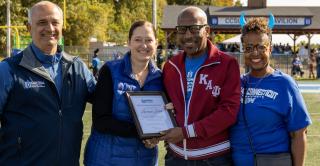
Central honors Admissions Director Larry Hall with Distinguished Service Award

Experiential Learning (EL) is a dynamic educational approach where students learn by doing and engage in reflection on their experiences (Kolb, 1984). Through hands-on, actively engaged experiences and focused reflection, students gain authentic and meaningful learning that unleash students' potential for growth and transformation. Experiential learning enhances knowledge, develops skills, clarifies values, and empowers students to contribute to their communities (AEE, 2024). Experiential learning is integrated into curricular and cocurricular activities, both on and off campus.
The EL Activity Types with Definitions are currently under development and review. Experiential learning is a broad term that encompasses a variety of different types of experiential learning activities. The university has categorized these experiential learning activities into three: Field and Work Based Experiential Learning, Global and Community Based Experiential Learning, and Project and Problem Based Experiential Learning.
The experiential learning activities in this category engage students in hands-on field and work-based experiences where they can apply their academic knowledge, skills, and abilities to investigate and work in the natural environment or workplace settings and situations. Examples include:
The experiential learning activities in this category engage students in hands-on project and problem based experiences where they can apply their academic knowledge, skills, and abilities to solve complex and novel issues as well as produce value-added projects, performances, and products in a variety of settings and situations. Examples include:
Capstones and Culminating Projects and Performances
Entrepreneurship, Labs, Portfolios and E-Portfolios
The classificational levels for experience learning are a taxonomic approach to arranging and assessing EL activities according to key components and features of experiential learning.
A course or co-curricular opportunity that engages students in a clearly defined experiential learning activity, integrating the components of learning outcomes, hands-on experience, and focused reflection.
A course or co-curricular opportunity that engages students in a clearly defined experiential learning activity, integrating the components of learning outcomes, hands-on experience, and guided reflection.
A course or co-curricular opportunity that engages students in a clearly defined experiential learning activity and integrating the components of learning outcomes, hands-on experience, and guided reflection as well as at least one from either integrative project, peer collaboration, or professional mentorship
The components and features of experiential learning have been adapted from Kuh, O'Donnell, & Reed (2013) and (Moffett (2023).
Learning outcomes for students to achieve at least partly through an experiential learning activity requiring a significant investment of concentrated effort over an extended period of time, framed with performance expectations set at appropriately high levels, and supported with frequent and timely constructive feedback. (Optional: SLO's are aligned to the AACU’s Value Rubrics, NACE’s Career Readiness Competencies, and SEE’s Principles of Practice.)
Hands-on experience for students to learn by doing through immersion and direct involvement in applications, contacts, exposures, operations, participations, or other engagement strategies within real-world settings or simulations that occur in the community, workplace, labs, expert-led environments, role-plays, or various other applied contexts and situations, rather than lecture alone.
Focus reflection is when the instructor, or the person who's in charge of experiential learning, highlights what parts of the activity could lead to student growth, and the student remarks on it and records it.
Guided reflection for students to critically reflect as a reasoning process to make meaning of an experience and discover relevance of learning, which works best when it is continuous as a part of structured exercises and prompts that contextualize, challenge, clarify, connect, review, and self-evaluate.
Integrative project for students to produce an artifact or demonstration of competence through e-portfolios, creative performances, entrepreneurship products, oral presentations, pitch decks, publishable works, research articles, and etc. that make connections among their hands-on experiences with knowledge and skills from the curriculum and co-curriculum often applied to novel and complex issues or challenges.
Peer collaboration for students to cooperate with other students and/or colleagues involved in mutual support of their hands-on experience through discussions and interactions about substantive matters that promote healthy discourse, interconnected teamwork, and intercultural competence with diverse people and worldview frameworks.
Professional mentorship for students to build relationships with a more experienced mentor such as a faculty, staff, alumni, partners, and/or supervisors involved in guidance and support of their hands-on experience through discussions and interactions about substantive matters that foster goal setting, constructive feedback, and professional development.
Visit CentralPulse to find volunteer opportunities on-and-off campus!