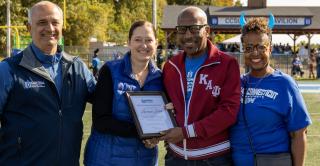
Central honors Admissions Director Larry Hall with Distinguished Service Award


Central Journalism students published a piece on CT Community News, a part of the Connecticut Student Journalism Collaborative. The site curates and publishes the work of student journalists in Connecticut to provide coverage of a wide range of under-reported local stories and showcase the work of the state’s best emerging journalists.
The piece, "Meet the Brotherhood," explores the work and role of the Brotherhood Initiative at Central. Read it below or online.
By Ronan Hinckley
For generations, men have been told to “tough it out.” They are expected to be stoic, be providers, suppress vulnerability, and handle their problems alone. These long-standing expectations have shaped how young men are raised in the world. But as rates of depression, anxiety, and suicide among men continue to climb, many organizations are recognizing the need to change the narrative.
At Central Connecticut State University, the Brotherhood Initiative, a men’s mental health and academic support program, has emerged as a response to the mental health and academic pressures for men attending university.
The group was founded in 2008 by licensed professional counselor William Fothergill. Back then, it was known as the Man Enough Support Initiative.
“This project emerged out of my creative research 18 years ago,” Fothergill said. “The programs we put together are student-led. We try not to separate academic issues from mental health issues because most of the time those things go hand-in-hand.”
The Brotherhood Initiative’s goal is to provide a space where young men can come together and discuss the problems they’re facing in the classroom or in their personal lives. It is led by Fothergill and by volunteer CCSU students who take time out of their day to tackle men’s issues that can otherwise be left unaddressed.
The Brotherhood lists its goals as:
Gender gaps
Research shows that men can face particular pressures in an academic environment, which then show up as gender gaps in achievement.
A 2021 study done by the American Institute for Boys and Men found that only 41% of bachelor’s degrees were earned by men, with this number expected to decrease over time. Further research done by data scientist Imed Bouchrika found that in public universities, 66.2% of women graduate compared to 60.2% of men.
One of the primary programs run by the Brotherhood Initiative is its weekly B-Men meetings, held every Tuesday at 6 p.m. in the Campus Tour Room of Memorial Hall. The meetings are structured around openness and personal connection.
It’s a forum that aims to teach young men how to deal with stressors in their daily life. Conversations are led by Brothers who have been in the program who act as mentors, passing along the information they received when they first joined the Brotherhood.
Topics at the meetings can vary depending on what’s needed in the moment. Some are focused on individual issues, while others tackle more systemic issues that affect all the men within the Brotherhood.
“The conversations are very open and fun and encourage Brothers to share their opinion in a space where they won’t be judged,” said Ashariel Velasquez, one of the participants.
“Usually at the beginning we are posed a question,,” he said. “Like, this week we were asked about different beauty products and if we need them to keep ourself healthy and fit. So, we all went around the room and shared our opinions. From there, the conversations in the meetings can go in any direction based on what the Brothers are experiencing.”
Through these conversations, the Brotherhood Initiative focuses on solutions; not simply naming problems, but actively working together to address them. The discussions are in a friendly, light-hearted environment and emphasize that men shouldn’t have to “tough it out” alone.
Many of the Brotherhood members have the option to live together on the same residential floor at CCSU.
“This made this, like, ten times better,” said Brotherhood member Marcus Guirand. “I feel like everybody on this floor at least has talked to me one time or knows my face. And there’s always honest and, like, cool interactions.”
Making the grade
Complementing the emotional support of the B-Men meetings is the initiative’s academic support system, particularly the “Making the Grade” study sessions held every Wednesday from 4 to 6 p.m. These study sessions are hosted in various classrooms around CCSU, depending on room availability in campus buildings.
The structure of these sessions is straightforward: having the Brothers meet in an environment where they can focus on their schoolwork and receive help from their Brothers to facilitate their academic success.
Tyler Little is one of the leaders of the “Making the Grade” study sessions. He said he has noticed tremendous growth amongst his peers and loves helping his fellow Brothers.
“We really just want to help college men get through college,” Little said. “Any college student can come, not just Brothers; we’re running these sessions to help with any homework or assignments students might have. It provides a community where like-minded students can meet and work towards our goal of graduating from college.”
Damar Glover said for him, the Brotherhood is all about community and bonding.
“It helped me academically because my freshman year I was struggling,” he said. “I have no support groups, no friends, no foundation — and the Brotherhood helped me.”
Another leader in the Brotherhood, Zion Caines, talked about the development he’s seen from his Brothers during his time in the initiative.
“When I first came here, Cade Snow was the elder brother. Seeing how he carried himself and stayed committed to the initiative through all the challenges of college was inspiring. He made the Dean’s List and graduated with very high honors. He’s a testament to what can be achieved through the Brotherhood Initiative.”
The Brotherhood also aims to help students in specific circumstances. For instance it connects Central students to statewide fatherhood resources through the Department of Children and Families’ Fatherhood Initiative. Another partner organization, the Sisters of the Brotherhood (SOB) was established as a vehicle to bring college women and men together to improve gender equity for all.
Outcomes
William Fothergill said the group’s activities have led to measurable outcomes.
“Within those in our core group, we have seen increased academic performance, increased ability to attend class, increased retention, increased graduation,” he said. “When we are talking about mental health support, we are one of the few support groups for men that have embedded mental health support, and I think that’s one of the reasons it’s been effective.”
Erin Drum, a child psychologist who runs Transformative Therapy Solutions based out of Orange, CT, said the work done by the Brotherhood Initiative mirrors a national trend addressing men’s mental health issues.
“I think it is absolutely wonderful,” Drum said. “Especially since it’s a men’s group. Because more and more of those are coming about. I actually have a client who is a member of a men’s mental health group, and it couldn’t be any more helpful for him … I think it’s incredible that this initiative is still going on only through volunteers.”
Constraints on support
Despite the successes that the Brotherhood Initiative has seen, there are still some struggles that they have had to work through. The main issue for the initiative has been funding and school support. Many members report the lack of school funding and budgetary constraints for the events that they have tried to run. Securing consistent meeting spaces has been a challenge at times, depending on the university’s scheduling and room availability.
Some members feel that other campus groups receive more consistent institutional support. A recurring sentiment from Brothers is that programs like the Women’s Center, which is well-established and highly visible, are able to obtain funding, dedicated staff, and promotional resources. Members of the Brotherhood Initiative emphasize that they fully support these groups and recognize the importance of their work, but they also feel that men’s mental health often receives less recognition, despite the increasing national concern around male student retention and mental well-being.
“The challenge for me is not getting the students to come,” Fothergill said. “It’s been how the institution has incorporated us onto campus. For example, men don’t have a center, women have a center. We don’t have a commission that reports to the president of the institution. We don’t have a place to call our own. All of our initiatives and programs have to be done on the fly because we don’t have a dedicated place to meet.”
Zion Caines and Drew Meyers echoed Fothergill’s sentiments.
“We hold meetings with faculty members or reslife on campus and at first they say they’re all up for our ideas,” said Caines. “Then later on they send emails or they tell us they’re not up for our ideas as soon as the semester starts. It’s like a culture to them, saying no when the time comes around is a habit for them.”
“We haven’t been able to do as much as we have wanted,” Meyers said. “But we try to take that challenge and learn from it. We have to hold our meetings in the Campus Tour Center, and it just is weird when other groups have their own space.”
Despite these institutional challenges, the initiative continues to produce meaningful outcomes for its participants. Brothers describe improved grades, stronger friendships, healthier coping strategies, and a sense of belonging that they struggled to find elsewhere on campus. Others say the initiative taught them leadership skills or gave them their first experience taking emotional health seriously.
Ronan Hinckley is a journalism student at Central Connecticut State University. This story is republished via CT Community News, a service of the Connecticut Student Journalism Collaborative, an organization sponsored by journalism departments at college and university campuses across the state.