Dr. Kimberly T. Kostelis appointed interim president

The Center for Africana Studies at Central Connecticut State University welcomed Professor Peter Wanderi of Mount Kenya University (MKU) to Central on July 14 for a day of discussions focused on strengthening global partnerships and advancing the integration of the United Nations Sustainable Development Goals into higher education.
Wanderi is the Chair for Industry, Innovation, and Infrastructure at the United Nations Academic Impact (UNAI) SDG 9 Hub.
Hosted by Oluwatoyin Awoderu, MBA, director of the Center for Africana Studies and co-chair of the Sustainable Development Goals initiative at Central, the visit began with a meeting with President Toro and academic leaders on campus to explore how the Sustainable Development Goals can be integrated into the curriculum while preserving faculty autonomy and course objectives. The discussion centered on aligning classroom instruction, research, assignments, and experiential learning with one or more of the 17 Sustainable Development Goals, enabling students to apply disciplinary knowledge to real-world societal challenges.
Wanderi and Toro also discussed a potential reciprocal partnership between Central and Mount Kenya University. Proposed areas of collaboration include faculty exchange, joint research initiatives, virtual exchange through co-teaching and shared educational resources, collaborative programming, and expanded student mobility through experiential and study abroad opportunities.
Toro emphasized the importance of building sustainable global partnerships that transcend time and institutional leadership. She highlighted SDG 9 – Industry, Innovation and Infrastructure as an ecosystem that supports long-term development, innovation, and sustainability across higher education.
Wanderi added that innovation extends across every discipline and that education itself is an industry driven by innovation. He further noted that infrastructure creates the foundation upon which the remaining 16 Sustainable Development Goals can flourish, making SDG 9 a catalyst for advancing the entire global development agenda. Dr. Jayanthi Kandiah, dean of the College of Health and Rehabilitation Sciences (CHRS), noted that SDG 9 and SDG 3 — Good Health and Well-Being — are equally vital for advancing the entire global development agenda.
Working with faculty
The visit also featured a faculty workshop titled “Integrating the United Nations Sustainable Development Goals into the Curriculum.” The session opened with an interactive SDG awareness exercise that invited faculty to identify the Sustainable Development Goals and reflect on their familiarity with the global framework. The workshop positioned the SDGs as a common language for teaching, research, community engagement, and student success while emphasizing their value in preparing graduates to address increasingly complex global challenges.
Faculty explored practical strategies for integrating the SDGs into existing courses without redesigning curricula. Participants learned that SDG integration can be as simple as connecting a lecture, assignment, course learning outcome, research project, service-learning experience, or study abroad program to one or more of the Sustainable Development Goals. Faculty also were encouraged to incorporate relevant SDG icons and language into course syllabi, classroom presentations, and instructional materials to make these connections more visible to students.
Representatives from colleges across the university participated throughout the day, contributing perspectives that demonstrated how every academic discipline can support one or more of the Sustainable Development Goals. The workshop reinforced that the SDGs are not limited to environmental or health-related fields and are meant to provide a flexible framework through which every discipline can contribute to sustainable development and societal impact.
An important point of discussion centered on faculty governance and academic freedom. Faculty emphasized that aligning courses with the Sustainable Development Goals remains an individual pedagogical decision rather than an institutional mandate. Because SDG integration does not require altering course content or learning objectives, faculty retain full ownership of how they incorporate the framework into their teaching, research, and scholarly activities.
Participants also explored the international visibility and opportunities created through engagement with the UNAI network, including collaborative research, community engagement, and access to future grant and partnership opportunities.
The visit concluded with a strategic meeting with academic leaders, including Dean Kandiah, who also serves as co-chair of the Sustainable Development Goals at Central; Dr. Helen Abadiano, interim associate dean of CHRS; and Professor Lemaire, chair of Physics and Physics Engineering and Advisory Board member for the Center for Africana Studies.
Discussions focused on establishing a sustainable institutional partnership between Central and Mount Kenya University, identifying pathways for long-term collaboration, and creating opportunities that advance global education, faculty scholarship, student engagement, and institutional excellence.
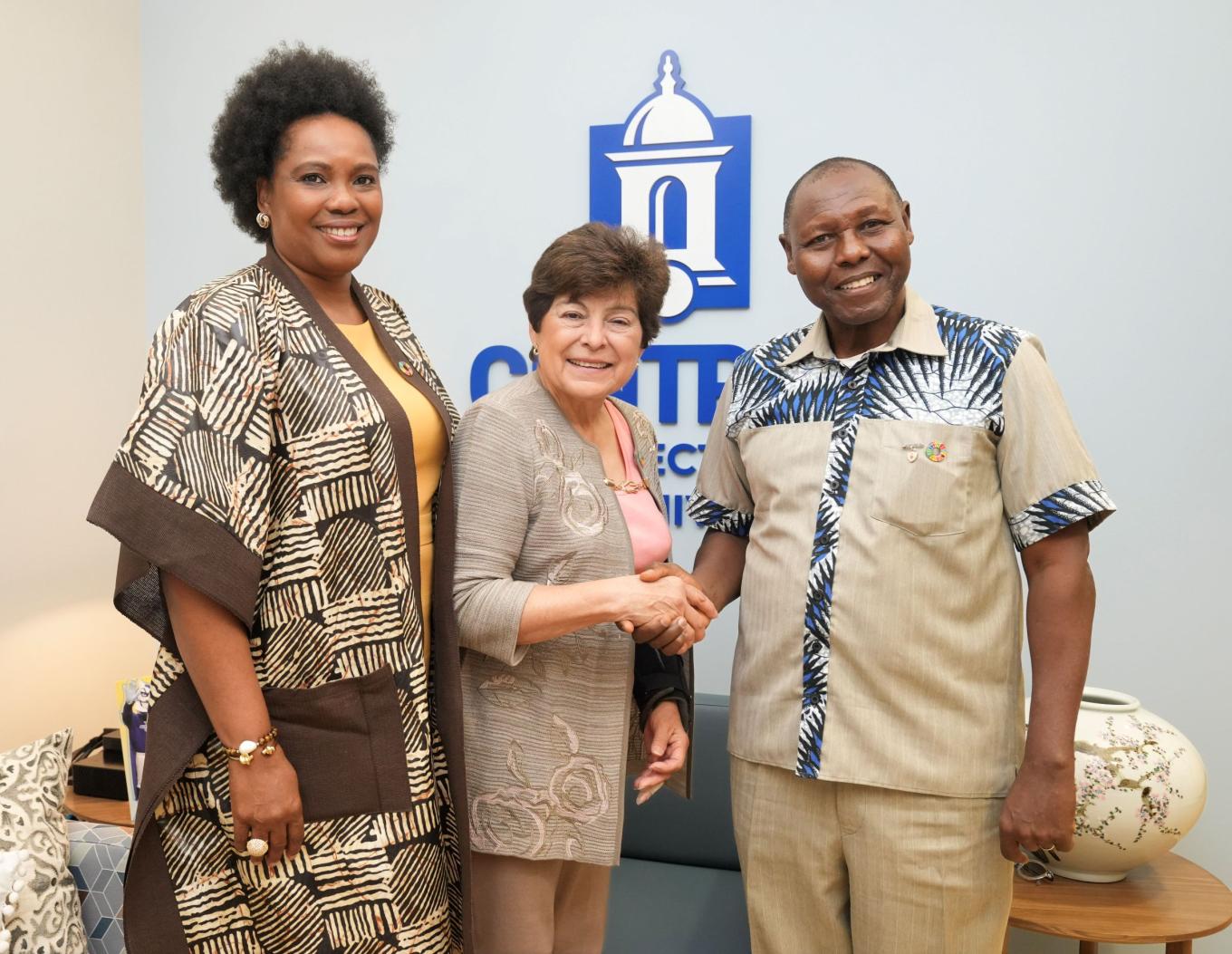
Oluwatoyin Awoderu, director of the Center for Africana Studies, President Zulma R. Toro, and Professor Peter Wanderi of Mount Kenya University are shown here in Toro's office. (Photo by Zachary Cunningham)