Central honors Admissions Director Larry Hall with Distinguished Service Award


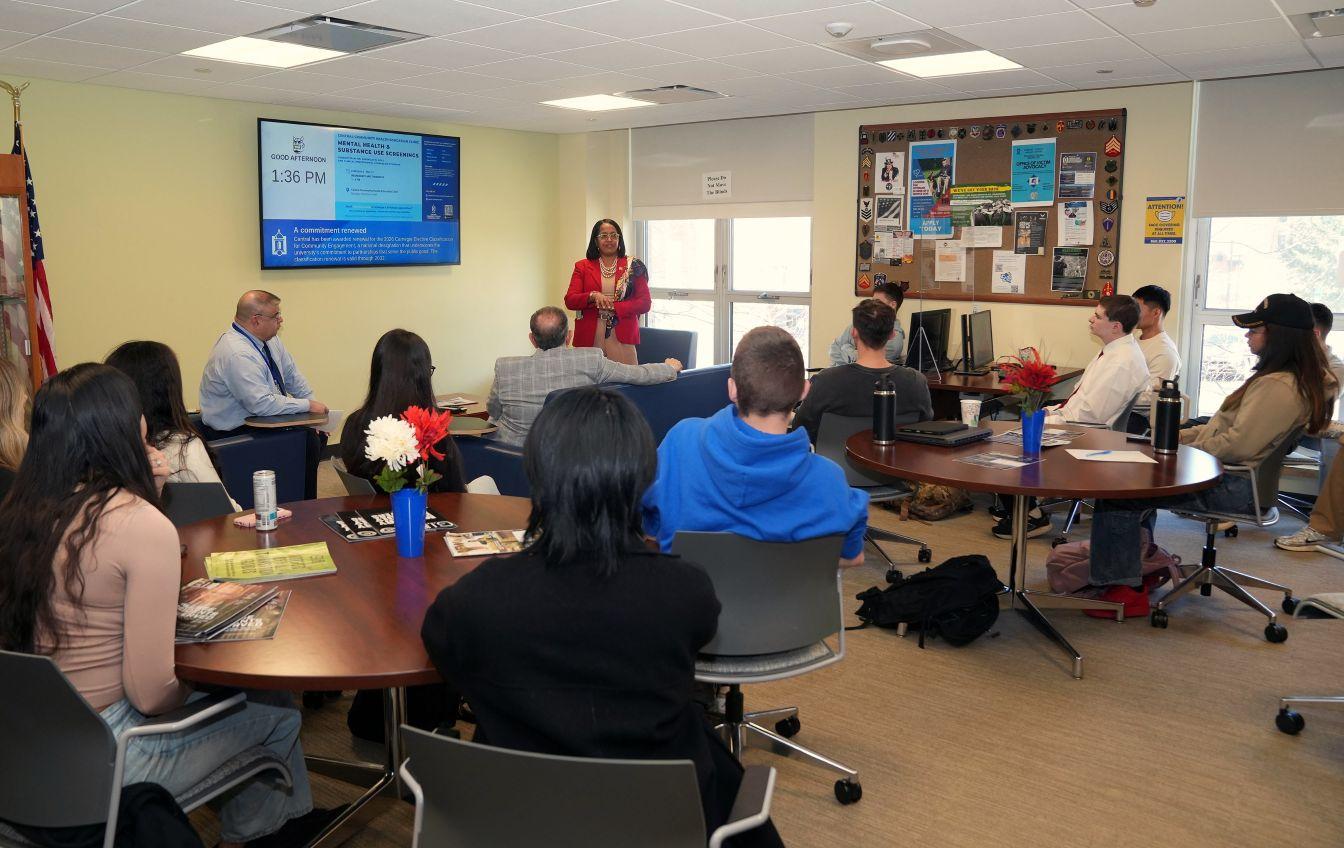
U.S. Representative Jahana Hayes (CT-05) visited Central Connecticut State University on April 8 to meet with student veterans and staff in the university’s Office of Veterans Affairs to discuss the evolving needs of those who have served, campus support services, and more.
President Zulma R. Toro welcomed Hayes and acknowledged Hayes’s longstanding support for veterans and the university, including Hayes’s help in advancing the university’s forthcoming Workforce Innovation Hub.
“I want to publicly acknowledge her support and dedication to the district that she represents,” Toro noted.
Hayes emphasized the importance of dedicated spaces for student veterans and expressed her appreciation for Central’s veteran support services.
“I'm really humbled by even being in this room, you know, to see that so many of you … made the choice to serve your country and then decided, okay, and I'm not done there. Now I'm going to go and pursue a college degree. It is quite remarkable,” she said.
She said student veteran centers provide a critical network of resources that boost retention and lead to better academic outcomes.
“When you talk about retention, I know how difficult it is to make sure all of those supports go together so that you can thrive academically,” Hayes said. “The fact that all of those things can happen right here for our veterans is really important.”
A graduate of Southern Connecticut State University who began her academic journey at Naugatuck Valley Community College, Hayes reflected on classmates who used GI Bill benefits and the life-changing impact of those programs. Hayes also discussed her legislative work, noting that six of the 11 bills she has passed relate directly to veteran services, including mental health care.
During a question-and-answer session, a student veteran described her experience as one of the youngest clients at a local VA clinic. She asked about the possibility of more mental health and health care geared toward younger veterans.
Hayes acknowledged the disparity, pointing to a whole new generation of veterans of conflict post-Vietnam and Korea.
“We have to have targeted supports that you can access, but also that are specific to your needs. For whatever it is—you may need child care in order to go to the VA, which another person wouldn't need. Those are things that we absolutely have to think about.”
Responding to a student’s question about current conflict in the Middle East and the potential for increased demand on veteran services, Hayes said the U.S. must be proactive in aligning its resources with emerging needs. She warned that future budgets must reflect that reality.
“You cannot put an increased strain on the men and women who serve without saying the supports will be in place.” She added that she could not support proposals that expand military capacity while cutting investments in housing, mental health care, and veterans’ benefits.
A student also raised concerns about cuts to ROTC scholarships and workforce pipelines. Hayes, a former educator, recognized the long-term value of early investment in such programs, calling such programs “incredibly important” for expanding access to opportunity.
On the issue of expiring education benefits, Hayes encouraged veterans not to assume ineligibility, noting that congressional offices can often help navigate exceptions or alternative pathways. “Don’t take for granted that you’re no longer eligible,” she said, pointing to underpublicized programs that support veteran education. She urged students to contact her office for help in getting their situation addressed by the VA.
Housing challenges also surfaced, particularly around recent policy changes affecting property tax exemptions and mortgage assistance for veterans. Hayes cited new data showing rising veteran defaults after support systems were reduced, calling the trend “staggering” and attributing it in part to cuts in staffing and technical assistance.
“It shouldn’t be this hard,” she said, stressing the need to restore resources that help veterans successfully transition to civilian life.
“If someone raises their hand in service of this country, there should be assurances that they’ll be taken care of,” Hayes said.