Central honors Admissions Director Larry Hall with Distinguished Service Award


By Savanna Yelling ’25
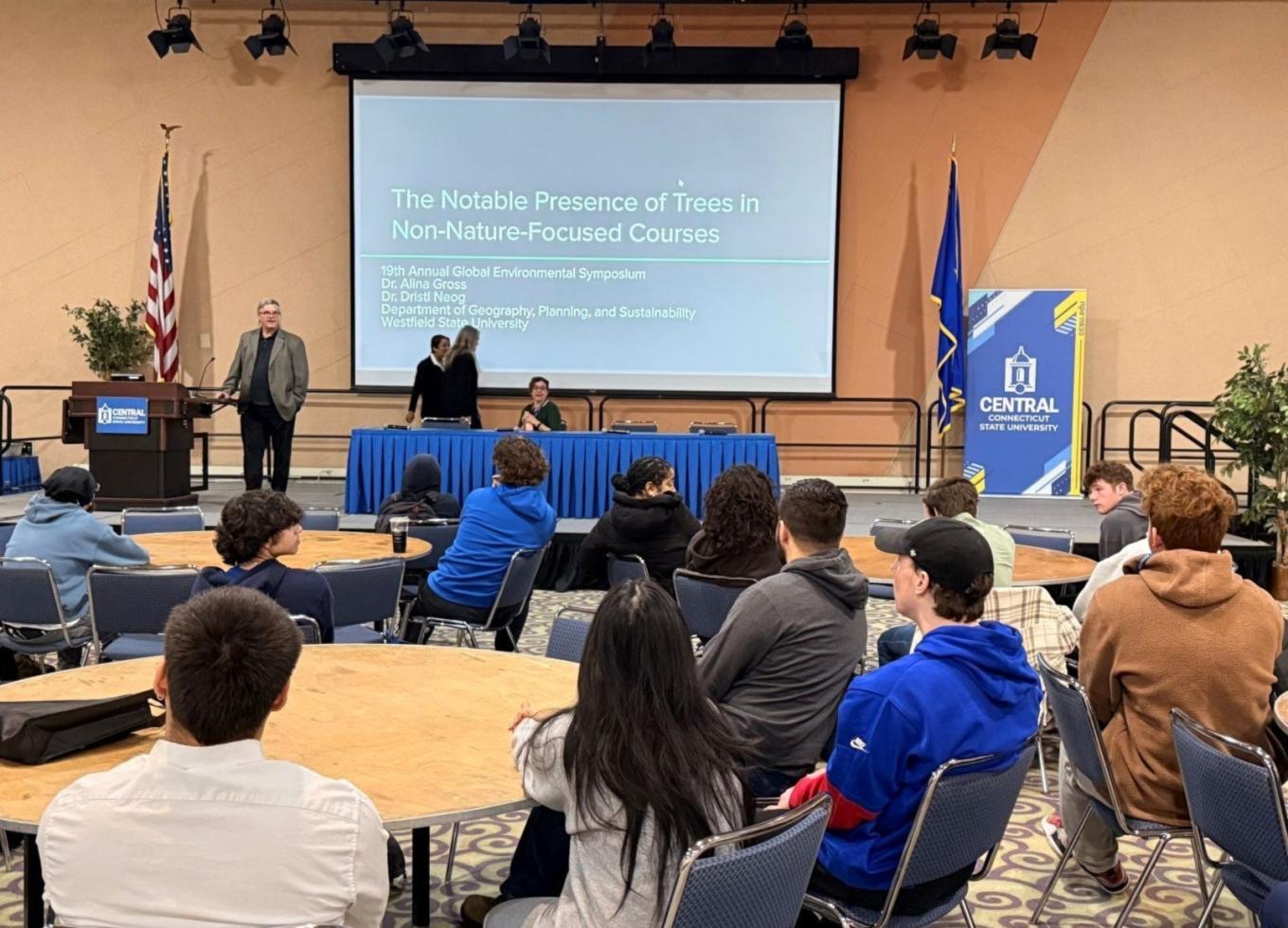
Trees took center stage at Central’s 19th annual Sustainability Symposium on April 9, where faculty and scholars explored the environmental, cultural, and social significance of trees in the face of climate change.
The daylong event, held in Alumni Hall, brought together students, faculty, and guest speakers for a series of panels examining how trees intersect with history, urban planning, and human well-being.
During the opening panel, history professor Dr. Leah Glaser emphasized the growing urgency of environmental challenges.
“We’re in trouble here with climate change,” Glaser said. “Trees are in trouble with climate change.”
Glaser connected trees to both historical and contemporary issues, referencing the Charter Oak as a symbol of Connecticut’s identity and tracing the roots of forest management in the state back to Yale University. She also highlighted how trees function as artifacts of culture, reflecting the values and priorities of the societies that shape them.
Beyond symbolism, Glaser pointed to redlining and segregation as factors that have historically influenced which neighborhoods benefit from tree-lined streets and green spaces.
“There’s an environmental social justice issue in terms of tree planting,” she said. “Trees have political, economic, social, and psychological importance to our history.”
A panel later in the day featured urban planners and scholars who expanded on these themes, examining how trees shape both physical spaces and personal identity.
Dr. Alina Gross of Westfield State University shared the role trees play in shaping human experiences, particularly for students.
“Trees are shaping their identity, which I think is an important thing,” Gross said.
The professors noted that their students connect environmental issues to broader topics such as housing, health, and community development.
Dr. Dristi Neog of Westfield State University offered a global perspective, drawing on her experiences growing up in India and referencing cultural and spiritual relationships with trees in Buddhism.
Neog also introduced the Japanese concept of “forest bathing,” or shinrin-yoku, which emphasizes the mental and physical health benefits of spending time in nature. She said such practices highlight the importance of seeing trees as more than just elements of urban design.
“Now I get to see trees beyond just green infrastructure or an urban design element because my students are teaching me that,” Neog said. “We can see a very strong connection to well-being.”
The event drew more than 30 students and faculty members and is part of Central’s ongoing efforts to promote sustainability through education and community engagement.