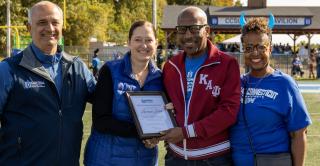
Central honors Admissions Director Larry Hall with Distinguished Service Award

By Julian Layne '25
As the United States approaches its 250th anniversary, Central Connecticut State University is bringing history out of the textbook and into conversation.
On April 20, the CLASS Tavern will transform the Bellin Gallery into a dynamic, immersive space inspired by one of the most influential institutions of the Revolutionary era: the tavern. Far from being just places to gather, taverns once served as engines of ideas, where political debate, cultural expression, and community life intersected in ways that helped shape a nation.
“The tavern was a colonial institution, the hub where all kinds of ideas were shared,” said Dr. Gil Gigliotti, professor of English and interim dean of the Carol A. Ammon College of Liberal Arts and Social Sciences. “We wanted to recreate that feel, since the tavern reflects the diversity of thought, focus, and energy of CLASS itself.”
The concept for the event was developed by Dr. Vivian Martin, professor of Journalism, who saw an opportunity to connect disciplines across the college while anchoring the experience in a powerful historical reality.
Before digital media, before instant communication, information moved through people, spaces, and shared experiences. Taverns often subscribed to newspapers, which were read aloud to patrons, turning these gatherings into early centers of public dialogue.
“I have long been intrigued by the role taverns and newspapers played in the Revolution,” Martin said. “With the 250th anniversary, I saw an opportunity to explore that idea in a way that brings people together.”
That vision quickly gained momentum and became a collaboration across departments, reflecting the interdisciplinary nature of the Ammon College of Liberal Arts and Social Sciences.
“This was a way for the disciplines in CLASS to share contributions from their perspectives,” Martin said. “We hope the event creates space for people to think about the experiment of the United States and perhaps inspire other celebrations.”
Throughout the day, the CLASS Tavern will offer a range of experiences drawn from the period, including music, poetry, and dramatic readings, alongside discussions that explore how ideas were formed, shared, and challenged during a defining moment in history.
For Gigliotti, the event is about more than reenactment. It is about connection. At a time when the nation is reflecting on its origins, the CLASS Tavern offers something more than commemoration. It offers participation.
“In CLASS, students and faculty examine what it means to be human,” he said. “How we think, create, gather, and govern ourselves, and how we reflect on the past to imagine the future.”
That perspective aligns closely with the mission of public higher education.
“It’s what public universities must do,” Gigliotti said. “Keep our citizenry aware of the past to better understand the present and prepare for the future.”