Central honors Admissions Director Larry Hall with Distinguished Service Award


By Julian Layne '25
For the first time in more than 50 years, humans have traveled beyond Earth’s orbit, marking a pivotal step forward in space exploration and a renewed opportunity for scientific discovery.
Conducted from April 1 through April 11, the Artemis II mission is being widely recognized as a technological milestone. For researchers and educators, its significance runs much deeper, shaping how we understand the moon, space travel, and humanity’s place in the universe.
“Humans haven’t traveled beyond Earth orbit since 1972,” said Dr. Kristine Larsen, professor of Earth and Space Sciences and astronomy expert. “What would happen if you hadn’t exercised any skill for more than 50 years? You would be woefully out of practice.”
That reality underscores the mission’s core purpose, reestablishing humanity’s ability to travel safely into deep space. While technology has advanced dramatically since the Apollo era, Artemis II represents a critical step in testing those systems in real world conditions, laying the groundwork for future missions to Mars.
But beyond engineering, the mission is also providing new insight into how humans interact with space itself.
“We are learning about the human/space interaction,” Larsen said, pointing to the physical and psychological challenges astronauts face, including radiation exposure, weightlessness, isolation, and the extreme forces of launch and reentry. “We need to think carefully about what it would be like to travel millions of miles to Mars, rather than the ‘mere’ quarter of a million miles to the moon.”
While Artemis II is primarily a technology driven mission, it has already revealed surprising details about the lunar environment.
According to Dr. Jen Piatek, professor of Earth and Space Sciences and planetary geologist, astronauts observed multiple impact “flashes” on the moon’s surface, more than scientists expected. These real time observations highlight a key advantage of human exploration.
“Our robotic missions are amazing, but they are not quite a substitute for a human on the surface,” Piatek explained. “A person can make immediate and educated decisions about what is interesting and where to go next.”
That ability has historically led to major discoveries, including the identification of “orange soil” during the Apollo 17 mission, later determined to be volcanic glass that revealed a more complex lunar history than previously believed.
Future missions aim to build on that knowledge, particularly by investigating the moon’s South Pole, where scientists believe ancient impacts may have exposed material from deep within the lunar interior. Studying these samples could provide critical insight into how the moon, and even Earth, formed.
“The moon is an excellent planetary template,” Piatek said. “What we learn there helps us understand the history of other planets and moons.”
Researchers are also focused on the possibility of water ice trapped in permanently shadowed craters, a resource that could prove essential for long term lunar habitation.
However, questions remain about how accessible or usable that ice may be.
As new data continues to emerge, scientists expect the unexpected.
“The more we learn, the more we tend to be surprised,” Piatek said. “We won’t know what’s going to surprise us until we go there. That’s the magic of exploration.”
For students, Artemis II represents more than a scientific breakthrough, it is a powerful reminder that space exploration is no longer a distant memory, but an active and evolving frontier.
“Space travel beyond Earth had become almost a myth to this generation,” Larsen said. “Artemis II made it stunningly real.”
She emphasized that the future of space exploration will require collaboration across a wide range of disciplines, not only in science and engineering, but also in communication, ethics, psychology, and the arts.
“The Artemis II crew reminded us that communication skills, ethics, teamwork, psychology, poetry, and artistry are just as central to the human condition,” Larsen said.
Ultimately, the mission offers a new perspective on Earth itself.
Quoting Artemis II Mission Specialist Christina Koch, Larsen reflected, “Planet Earth, you are a crew.”
From space, the divisions that define life on Earth disappear, replaced by a shared sense of humanity.
“We are simply, and uniquely, humanity,” Larsen said. “We need to think about that more often.”
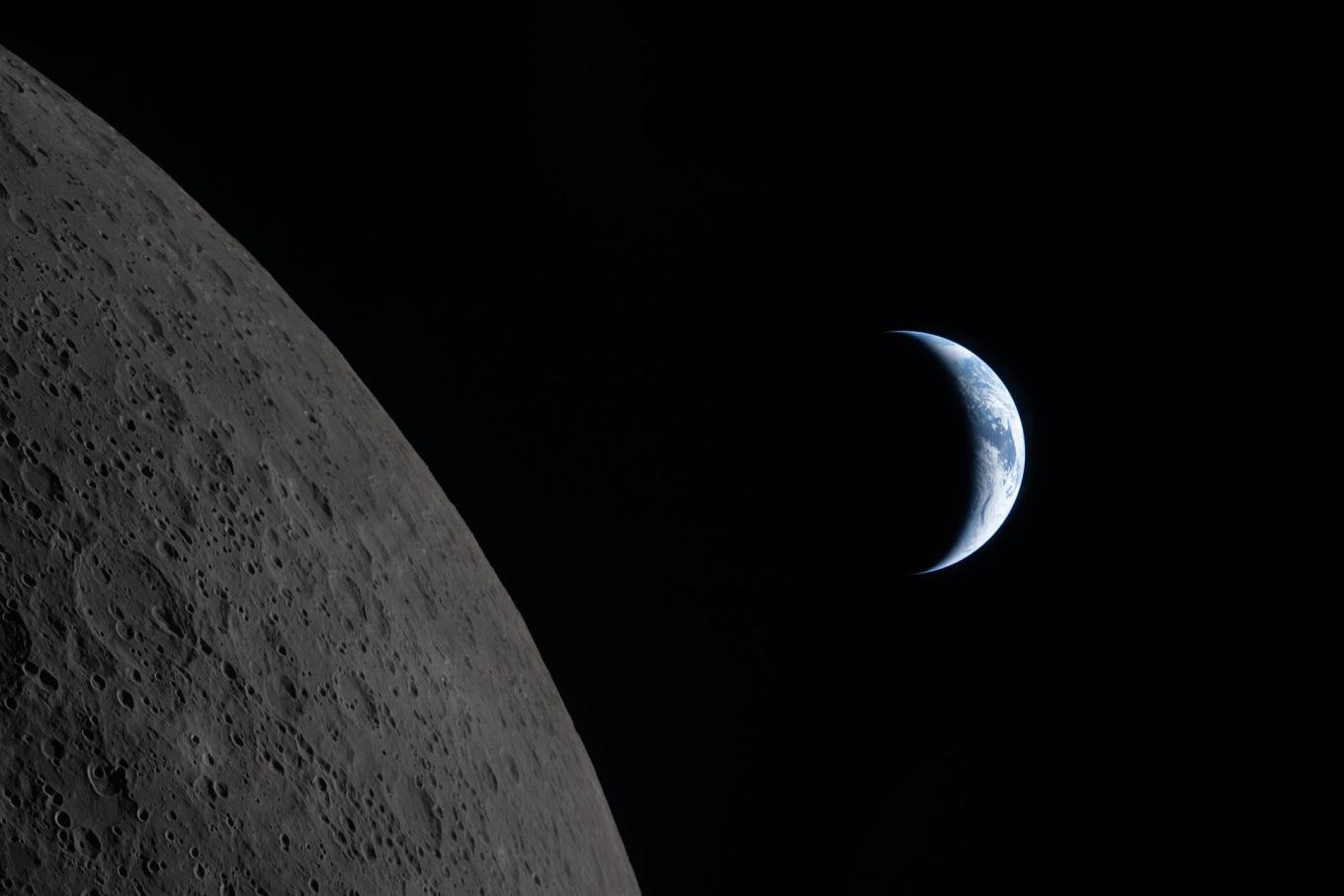
Earth draws closer to passing behind the Moon in this image captured by the Artemis II crew during their lunar flyby, about six minutes before Earthset. Earth is in a crescent phase, with sunlight coming from the right. (Image courtesy of NASA)
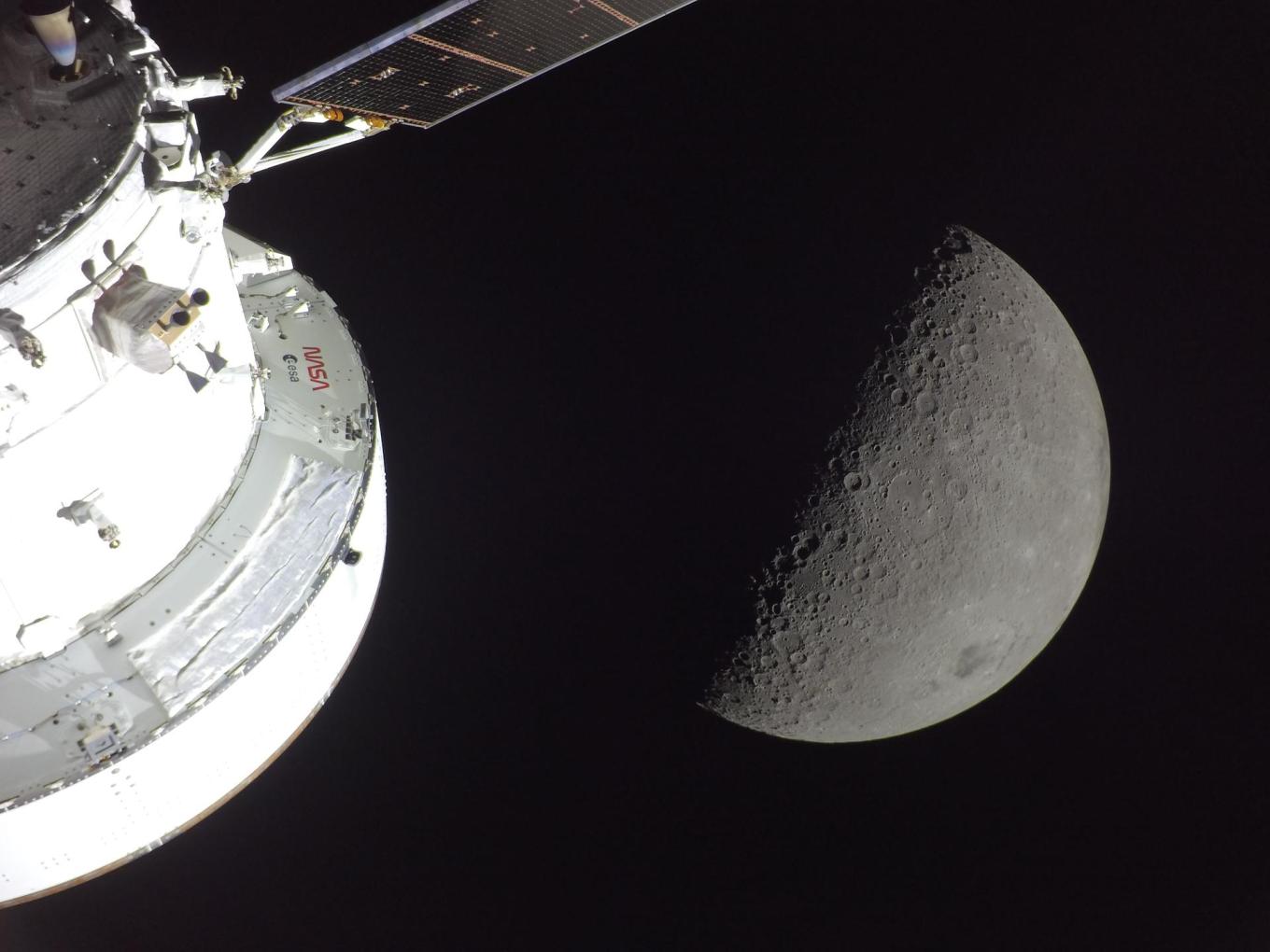
NASA’s Orion spacecraft is seen in the foreground, lit up by the Sun. A first quarter Moon is visible behind it, with sunlight coming from the right. Near the bottom right edge of the Moon, Orientale basin stands out with a black patch of ancient lava in its center. Orientale is a 600-mile-wide impact crater that straddles the near and far sides of the Moon and is ringed by mountains. (Image courtesy of NASA)