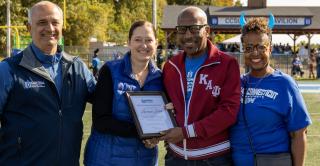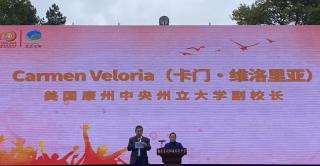
Central delegation travels to China to celebrate C.J. Huang

In an increasingly global society, a world’s worth of opportunities are available to college students—literally.
Advances in technology, communication, and university partnerships have made study abroad and exchange programs easier and faster to navigate with far fewer logistical hurdles.
And so, as part of their ongoing assessment of how the university can draw and retain new students, President Zulma R. Toro and her team are looking well beyond Connecticut’s borders.
“One of the strategies that we identified for us to enhance enrollment and make the university more attractive to domestic students was to reach out more to international students,” Toro says.
Global engagement supports ongoing university efforts to distinguish Central as a destination institution known for its high-quality, unique, and engaging educational experiences, including international collaborations in research and programming.
“Global engagement is really about establishing very strong relationships with partner universities abroad, so we can have projects in common in which faculty from those universities collaborate with faculty members here, and students from here go there or work on the same projects,” Toro notes.
International travel and exchange programs also build a sense of global citizenship and enhance academic and career outcomes in Toro’s view.
“I think that exposing our students, our communities, our faculty and staff to what is going on in other places is extremely important,” Toro says. “My ideal educational experience for Central students would be one in which students come here, and, no matter what major they are pursuing, they will complete two experiential learning opportunities—and one would be a global experience.”
Plus, scholarship funds in the U.S. and more available through governments abroad make travel an achievable dream for more students than ever.
Toro has since set a priority to build on Central's relationships abroad with a focus on specific regions around the world that reflect Central’s own goals toward academic success and workforce readiness.
Going forward, Central will work with partners in Spanish-speaking countries including Spain, the Caribbean, and Latin America, as well as Europe, Asia, China, and, as of 2024, Africa, which represents an exciting region for cultural and educational exchange. According to United Nations data, the world will have nearly 1.3 billion young people (“young” meaning those age 15 to 24 years) by 2030. Young people in Africa will make up a significant portion of the global total, expected to account for 42 percent of all young people worldwide by the same year.
As of Fall 2025, Central partners with about two dozen universities in nearly as many countries, as well as international corporations and agencies that expand travel opportunities.
The university also appointed its first Global Engagement Faculty Fellow, Dr. Lourdes Casas, who has already strengthened university partnerships in Spain and Spanish-speaking countries. Other programs, such as the Connecticut–Baden–Wuerttemburg Faculty Mobility Program with Germany, send professors abroad to share their expertise.
Support for international students continues to grow, with expanded campus employment, new community-building programs, and a welcoming International Students Lounge on the fourth floor of Barnard Hall.
The university also introduced the Student Global Engagement Ambassador Program, which offers students financial support in exchange for creating photos and videos that boost Central’s international presence on social media.
What is Global Engagement at Central?
What is now called Global Engagement at Central encompasses three existing units that are housed in Barnard Hall: Study Abroad; International Student & Scholar Services; and the Intensive English Language Program.
There are several Study Abroad (SA) options for students, including Courses Abroad, which are short-term, credit-bearing classes taught by Central faculty during Winter Session, Summer Session, or embedded in Spring semester courses. Enrollment in the short-term courses represents a great majority of students who opt to study abroad.
Independent Summer Abroad programs offer students the chance to earn credits through direct-enroll experiences in the summer, with varying costs, dates, and course offerings.
Semester Abroad programs include Central’s full-semester partnership and exchange programs, approved third-party programs, and non-sponsored programs.
International Student & Scholar Services (ISSS), led by Oluwatoyin Awoderu, advises and supports international scholars, exchange students, degree-seeking students, and students in the Intensive English Language Program. ISSS aims to cultivate a supportive environment that attracts and retains international students and scholars.
Awoderu joined the ISSS office in 2004 and now serves as its director. She is also the director of the Center for Africana Studies and brings extensive knowledge and ongoing research on the African diaspora to ISSS.
Expanding horizons
Recent data shows that Central students are more than curious about international travel.
During the 2024–25 academic year, 175 students took part in study and course abroad programs—up from 134 the previous year.
In 2025, 1.78 percent of the Central student population participated in a study abroad program. Nationally, that percentage falls to 1.51 percent, according to the NAFSA Association of International
Educators. In Connecticut, NAFSA reports that 2.19 percent of students opt to study abroad, but International Education Coordinator Dr. Zongxiang Mei notes that figure includes students who attend public and private universities, such as Yale and Connecticut College.
Mei says that lack of funding is among the top reasons why students do not pursue study abroad opportunities, which is why a significant role of her office is to educate students and faculty about the many scholarship opportunities available for international travel.
In recent years, a $300 scholarship was made available for first-year students, and additional funds support students with strong grade point averages. Partner universities also offer their own incentives to American students, and external funders such as the federal Benjamin A. Gilman International Scholarship Program, USA Study Abroad, and the Japan Student Services Organization (JASSO) offer additional sources of support.
Mei serves as an advisor and selection panelist for the Gilman program and frequently collaborates with her colleagues throughout the Connecticut State Colleges and Universities system to research new funding opportunities in the U.S. and abroad.
Awoderu secured funding this year for a group of 25 Pell-grant-eligible students to acquire their first passports at no charge, eliminating close to $200 in fees from a student’s travel expenses. The new Passport to Global Empowerment program will be funded next year, too, supported in part by the Office of the President and the nonprofit Institute of International Education.
Additional support came courtesy of the Provost’s Office this year, which will now cover travel expenses for faculty members who lead course-abroad programs. (Story continues under photo.)
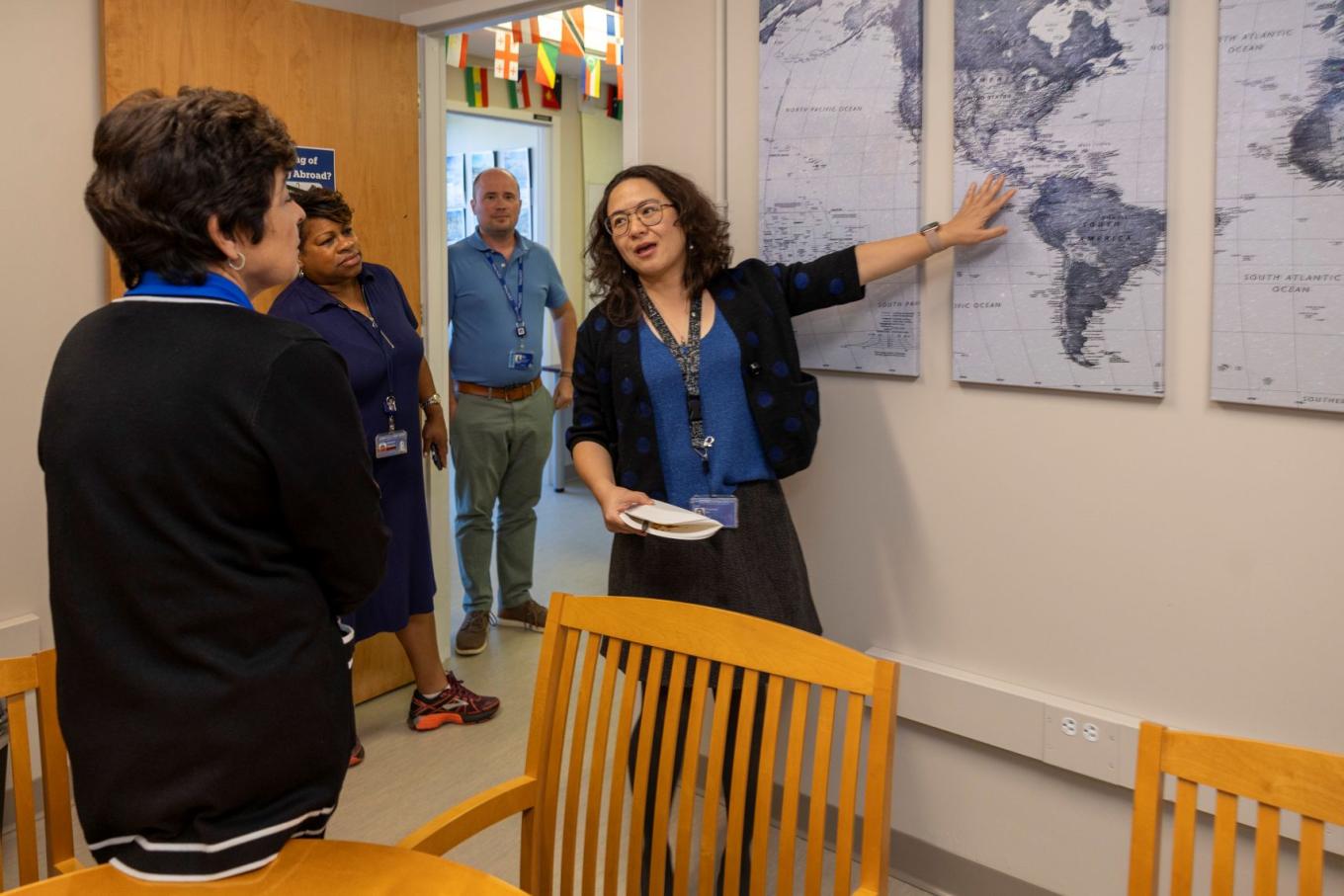
International Education Coordinator Dr. Zongxiang Mei points out new travel destinations for Central students in conversation with President Toro during an Oct. 1, 2025, Global Engagement at Central open house. (Photo by John Henninger)
Breaking barriers
Other than funding, barriers to travel vary among today’s students, from lack of language skills or no passport to inexperience and basic nerves around travel. Both the study abroad office and ISSS have gone full speed ahead this semester already, with several informational sessions and social events planned for students who want to learn more about programs, scholarships, and support services for exchange students at Central.
Mei says years of conversations with students have informed her outreach work.
“I want to hear from them first and figure out with our existing, sometimes limited resources, how we can help them remove the barriers, the challenging parts, to study abroad,” she says.
So far, the feedback has been positive from students who have traveled to or from Central, and Mei and Awoderu have seen for themselves what their investment in student success can do.
“It's really inspiring to see students actually do well, even those that struggle at first,” Awoderu says. “It's also very inspiring to figure out how to help them because each person is different, so you have to really think on your feet and take them to the different offices sometimes just to make sure that they don't feel alone.”
Awoderu employs the same approach to international student recruitment and retention as the university does with domestic students: Celebrate their successes; support them as much as possible; and offer them a transformative experience.
Where Mei works with her counterparts abroad to support her student travelers, Awoderu is tasked with providing the distinct support that international students need, including immigration regulations, work authorization forms, and academic paperwork.
“I have always worked with international students,” Awoderu says. “It's been a great pleasure, and it's great to watch the students come in and see them transform. At first, they are like ‘I don't know what I'm getting myself into,' and then they get here, and they ask questions and before you know it, they are comfortable enough and are integrated into the Central family, and then they keep going.” (Story continues under photo.)
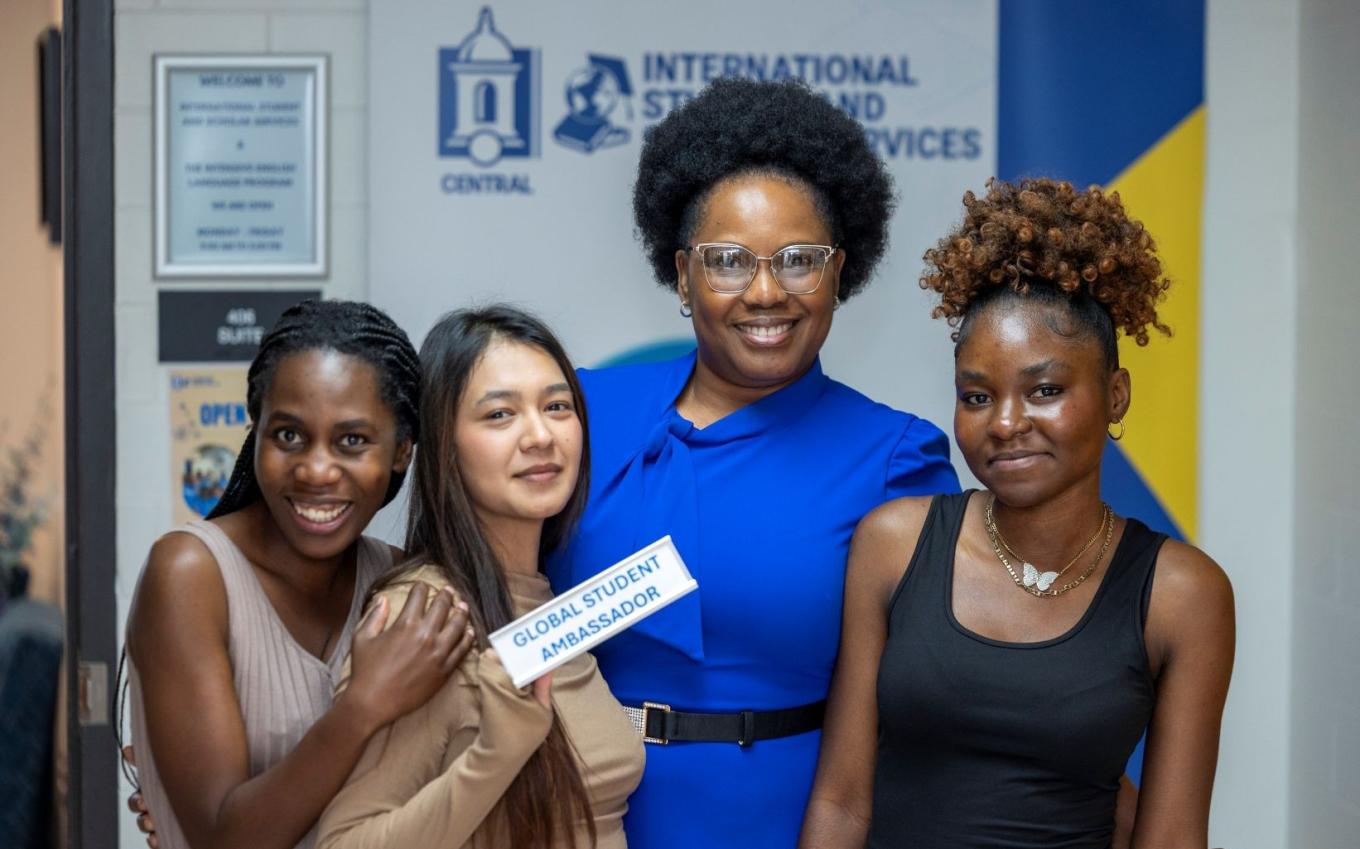
Oluwatoyin Awoderu greets some new international exchange students during an open house event on Oct. 1, 2025, at Barnard Hall. (Photo by John Henninger)
Following El Camino
But the journey doesn’t stop there.
An emerging program called Central Discover Abroad will offer opportunities to anyone who’d like to travel with the Central family.
On these trips, Central faculty and staff will lead travel experiences open to the public that draw on the university’s global partnerships to offer immersive cultural experiences.
Among its flagship voyages is one inspired by President Toro’s own travel to Spain, where she completed a 72-mile stretch of the Camino de Santiago last spring.
The Camino de Santiago is known as a pilgrimage route that draws nearly 350,000 people a year. Known simply as “the camino,” it is a network of seven paths that stretch across Spain. Paths range from 70 miles to more than 600, but all of them lead to Santiago de Compostela in northwest Spain.
The Camino de Santiago is marked by scallop shells on signposts, and the shell is featured in artwork and architecture along the route. The shell is said to symbolize the journey of the pilgrim, with its grooves and ridges suggesting the different paths one can take in life. Today's pilgrims often wear a scallop shell on their gear in a nod to their predecessors and fellow hikers.
Toro’s experience was so meaningful, she suggested it as an option for participants in the Office of Professional Education’s Scholars for Life program. The program offers lectures and presentations by Central faculty to the public, and it has gained a loyal fanbase, particularly among Central alumni. Plans are in the works for a group trip along the camino from May 30 to June 9, 2026.
Or, travelers can mark their calendars for the summer of 2026, when a group will travel to Edinburgh, Scotland, for 10 days during the Edinburgh Festival Fringe. Working with partners at Queen Margaret University (QMU), Central’s group will have accommodations at QMU and enjoy scheduled activities tailored for the group, including guest professor lectures and educational tours.
Another initiative in development is to establish an exchange program of sorts for employees of Connecticut companies that have headquarters in partner-university host countries. Already, Central has an agreement with the German company Trumpf, based in Ditzingen, Germany, with North American headquarters in Farmington, Conn.
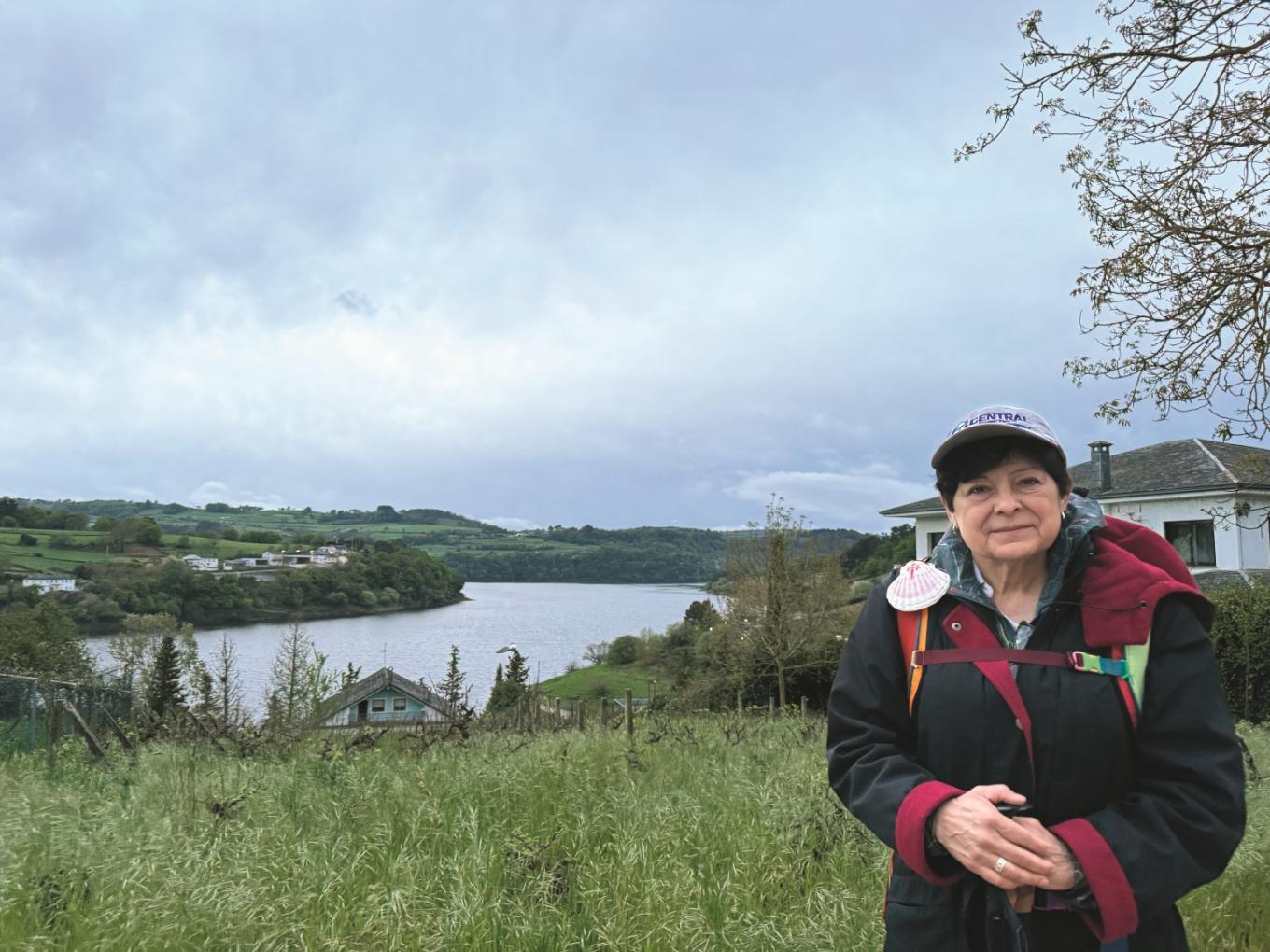
President Toro pauses during her 70-mile trek across Spain along the Camino el Santiago.