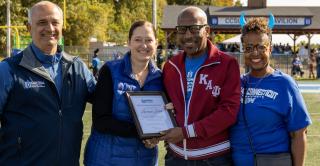
Central honors Admissions Director Larry Hall with Distinguished Service Award



Stacey Close, Ph.D.,
Professor of History, Eastern Connecticut State University
Distinguished Keynote Speaker
In 1839 Connecticut newspapers began to report about a black schooner spotted off the coast of the state. The people of the state, after the U.S. Navy captured the vessel, learned that most of the people aboard the Amistad were people of African ancestry; however, the full story of those on-board would be unraveled through the legal system in both Connecticut and Washington, D.C. In 1990 historian Merton Dillon published Slavery Attacked, which focused on the long struggle of Black people and their allies in the fight to dismantle and destroy chattel slavery in the United States. The ordeal and resilience of Singbeh Pieh, of Mende identity, left a lasting legacy in the state.
By the time of the capture of the Amistad by the Mende freedom fighters, the institution of slavery in Connecticut was over two hundred years old. Connecticut slave owners and dealers bought and sold Africans on the steps of the Old State House in Hartford, Connecticut. The state of Connecticut once had an enslaved population of over five thousand people, which made it the largest slave population among the New England states. Newspapers, deeds, and wills all establish the place of slavery in Connecticut. Connecticut slave ship captains, like those from Rhode Island and Massachusetts, continued the barbaric trade. While not on the scope of plantation slavery in the South, slave owning in Hartford, New London, Wethersfield, and other Connecticut towns was a well-established practice in the 18th and 19th centuries.[1]
Louis Berbice, who was enslaved at the Dutch Fort, was one of the first people of African ancestry, that entered the public record. In 1639, Gysbert Opdyck, who owned Berbice and worked out of the Dutch Fort, killed the young Berbice.[2] African people, when the opportunity came in the colonial period, engaged in resistance to enslavement. In 1657 a group of Africans and Native Americans destroyed the homes of whites in Hartford.[3] In 1702, Abda, son of a woman of African ancestry and a white man, lodged a countersuit against Thomas Richards, his former owner, after he fled to the home of Captain Wadsworth in Hartford. The counter claim resulted after Richards sued for the return of Abda. Before the Court in 1704, Abda claimed that because he had white blood Richards had no right to enslave him. The court agreed and required that Richards provide damages to Abda. Richards appealed the decision to the General Assembly, and they reversed the decision based on the fact that Abda was born of an enslaved mother.[4]
With the onset of the American Revolution, African American community leadership made a call for an end to slavery, while white leaders in colonies offered freedom for enslaved African Americans that willingly agreed to fight on the battlefield against the British. After the revolution and victory over Great Britain, Connecticut began the gradual emancipation of its enslaved population.
Even so, the fight for freedom and equality was difficult in the state. In 1831, eight years before the rebellion aboard the Amistad, a white mob stormed through the New Liberia section of New Haven and “dragged out and arrested” local whites. The major focus of the raid was William Lanson, the wealthiest business owner in the African American community. Though the area reportedly was known for harboring vice, prostitution, and “race mixing,” the local police force did not locate evidence regarding the crimes they attempted to uncover. Police Officer Jesse Knevals testified in court that he observed no “bad conduct in houses owned by William Lanson.” Both Lanson and his son strongly argued that he had no connection to illegal activity. Lanson served as one of the key links on the Underground Railroad in New Haven and also had a niece that attended Prudence Crandall’s School in Canterbury.
In this same year, local white leaders and Yale officials resoundingly voiced opposition to a Negro College in New Haven. Rev. Simeon Jocelyn initially believed that New Haven and Yale would support the building of the college, whose focus would be the mechanic arts. Benjamin Lundy, one of the leading voices calling for gradual abolition of slavery, broached the idea of the college with the Connecticut legislators. Opposition among whites in the city of New Haven was strong. It included Yale leaders, local democratic newspapers, and hundreds of whites that voted against the establishment of the Black college. Whites feared that the presence of the Black college might lead to a rebellion similar to Nat Turner’s Rebellion, Black students forming relationships with whites, and job competition in the mechanic arts.
Both white and black abolitionists sometimes paid a heavy price for their involvement in the movement. Such was the case for William Burleigh. Because of his strong opposition against U.S. involvement in the Mexican War and abolition, in 1840, a mob of anti-abolition whites pillaged and burned his office on State Street.[5] Deacon James Mars, another prominent member of the African American community and the Congregational Church, condemned Connecticut leaders for permitting slavery, but claiming to have ended slavery.
In his narrative, James Mars wrote about a Georgia slave owner that brought an enslaved woman named Nancy to Hartford to provide care for his family. Members of the local anti-slavery society drew up a writ to help Nancy acquire her freedom. The group hired William W. Ellsworth, a respected local attorney, to argue for Nancy’s freedom. Deacon Mars agreed with the local society and signed the petition that demanded Nancy’s freedom As a result, a group of angry white men first suggested that an attack on Mar’s house might be necessary, then they suggested that simply beating Mars might be enough to teach the upstart deacon a lesson.[6] Unafraid of the threats, Mars refused to cower or hide.
When Thomas Gallaudet learned that European slave traders captured and sold Prince Abdul Rahahman, a wealthy and powerful native of Guinea in West Africa, into slavery, the head of Hartford’s local asylum for the deaf and dumb supported efforts in the anti-slavery movement to help Rahahman return home. European slave traders sold the native of Guinea, West Africa, into slavery in the area near Natchez, Mississippi. An intervention by a white physician that he knew in Africa, who happened to be visiting Mississippi, coupled with the support of a sultan, President John Quincy Adams, and Henry Clay led to his freedom. The prince traveled to the North speaking with abolitionists and supporters to raise funds for his return to Guinea. During a visit to Hartford, Rahahman, to his surprise, encountered an aged Fula, who served as a former member of his homeland’s military in Guinea.
In 1839 Portuguese human traffickers took more than five hundred people in the area of Sierra Leone for transportation aboard the notorious slaver Tecora for eventual sale in Cuba. Once in Cuba, Singbeh Pieh was one of the Africans chained, sold and loaded aboard the ship Amistad, whose final destination was a plantation on the island. Singbeh Pieh managed to pull a nail from the ship, which he used to unlock his shackles and those of other African men aboard the ship. Among the fifty-three people from Sierra Leone aboard the Amistad were four children, three of whom were girls. Armed with sugar cane knives, the men, in their fight for freedom, killed the captain and cook, who sadistically had indicated that the captives, were going to be cooked and eaten by their captors. While some crew members managed to escape overboard, the rebel freedom fighters that seized the ship demanded that Pedro Ruiz and Jose Ruiz, Spaniards held aboard the ship, navigate the ship eastward back to their homeland.[7] During the night, the Spaniards steered the ship towards the United States coastline, where on August 26, 1839, the U.S.S. Washington located the Amistad off Long Island. Naval personnel again chained the Mende people and towed the ship into New London, Connecticut. Naval officers chose Connecticut because they knew that doing so afforded “salvage rights to the ship and human cargo.”[8] Once docked in New London, naval officers and personnel marched the Mende to the jail at New London, where the historic Shiloh Baptist Church now sits.
Officials moved the Mende, now prisoners, from New London as their case caught the attention of abolitionists, the Spanish government, and President Martin Van Buren of the United States. On September 17, 1839, Hartford’s Daily Courant reported that writers visited with the Africans and found them to be a “fine looking set and appear remarkably cheerful and happy.” Singbeh Pieh remained in New London for the moment. Hartford officials decided to callously offer the public an opportunity to view the Africans for twelve and a half cents per person to anyone that visited them in the apartment where they were held.[9]
The Daily Courant later included information on Singbeh Pieh being brought to Hartford from New London, while the Commercial Advertiser included information on Thomas Gallaudet, who served as the head of the asylum for the deaf and dumb, attempting to communicate with the Mende using sign language. The reuniting of other Africans with Singbeh Pieh was a joyous occasion for the group held in Hartford, while Gallaudet’s efforts proved successful only in him concluding that Africans understood the notion of a supreme being and “rewarder or punisher for human actions.” Nineteenth century views that white Americans held about the alleged “inferiority” of Native people and African people were also revealed. While the paper highlighted the efforts at communication, the Commercial Advertiser reporter also considered the Africans held at Hartford to be “quick in their movements” and “have intellects as acute as those of our Indians or, of any uncivilized people.”[10]
Sensing the importance of the moment, Lewis Tappan, Simeon Jocelyn, Rev. Joshua Leavitt, and other abolitionists united to organize the legal defense of the freedom fighters aboard the Amistad. They enlisted the linguistic skills of Josiah Gibbs, a philologist at Yale University, which led him to learn that the people were Mende. Gibbs visited the New York docks and waterfront, where he met James Covey. Covey, a native of West Africa, spoke the language of those kidnapped in 1839, which provided an opportunity for the Mende to tell their own story about how and where they were captured. While the U.S. district court and circuit courts ruled that the Mende had been illegally stolen into slavery, the attorney for the United States decided to appeal the case to the United States Supreme Court. While Roger Sherman Baldwin, a talented attorney from Connecticut, won early arguments for the freedom of the Mende, Lewis Tappan and other abolitionists convinced former President John Quincy Adams to also make an argument before the Supreme Court in defense of the Mende. Seventy-three year old Adams, now a member of the House of Representatives, had already won before the Supreme Court. Known for his anti-slavery views, Adams succeeded in forcing the house to end the rule “banning debates about slavery.” In 1841, Adams, in a two-day and seven-hour argument before the Supreme Court, stated that President Van Buren abused his power and that Singbeh and Mende had the right to fight for freedom. He then turned to the Declaration of Independence and that “every man has the right to life and liberty, an inalienable right…” On March 9, 1841, the Supreme Court agreed with the lower court that the Mende were free people that were illegally stolen into slavery. Even so, the United States government refused to provide means for the Mende to return to Sierra Leone. The courts had already granted salvage rights to the two naval officers aboard the U.S.S. Washington.[11]
African American and white allies organized efforts to aid in the support of the Amistad captives return home. Rev. James W.C. Pennington, pastor of the local African American Congregational Church in Hartford, Connecticut, was at the forefront of forging the Union Missionary Society, which became the American Missionary Society. Pennington, who earlier rebelled by running away from slavery in Maryland, played an instrumental role with the society in working to fund the travel of the Amistad freedom fighters back to Sierra Leone. A May 1841 public meeting of African Americans focused on both the safe return of the Mende people to Sierra Leone and effort to send missionaries to Sierra Leone. Pennington considered the return of the Mende to home to be divinely inspired. On November 21, 1841, Pennington offered prayer at services at the Broadway Tabernacle in New York for the departing group. Included were two members from his church, Henry and Tamar Wilson. While Henry, a tailor, and his wife decided to devote their lives as teachers in West Africa, the two were also missionaries, who planned to proselytize among the people of Sierra Leone.[12]
Two years after the Amistad rebels freed themselves from Spanish slave traders, the United States learned that a group of rebels on the Creole, a slave ship that carried one hundred and thirty-five enslaved people from Norfolk, Virginia, wrenched control of that ship from slave traders and sailed to freedom in the British controlled Bahamas, where slavery no longer existed. The seizure of the ship in 1841 reaffirmed that people of African descent caught in the trade, whether directly from Africa or in states, wanted to be free. Virginians remember Gabriel Prosser and Nat Turner, while South Carolina remembered Denmark Vesey and his ties to Haiti. Four years after Turner’s rebellion in Virginia, in 1835, enslaved people in Bahia, Brazil battled for their freedom. From 1831-32, Sam Sharpe and fellow rebel fought to free themselves in Jamaica.
Aboard the Creole, Madison Washington and three other leaders, Elijah Morris, Doc Ruffin, and Ben Blacksmith, forged a determined alliance amongst themselves and fifteen others to carry out the ship’s capture, and to navigate the vessel to the British Bahamas to freedom. In 1839, Washington, enslaved in Virginia, escaped through the Underground Railroad to Canada, but in 1841 he decided to return south to free his wife in Virginia. Before the trek to Virginia, he stopped at Philadelphia, where he visited with abolitionists Henry Garnet, Hiram Wilson, and Robert Purvis. The three attempted to dissuade Washington from following the railroad back into Virginia. During his visit with Purvis, the abolitionist unveiled “Sinque, the Hero of the Amistad,”a portrait of Singbeh Pieh, the hero of the Amistad. As Purvis relayed the saga of Singbeh Pieh and the Amistad freedom fighters, he noticed that Washington excitedly absorbed the story from start to finish. On his return to Virginia, just as the abolitionists in Philadelphia feared, Washington was captured and sold again into slavery, but this time his destination was to be Louisiana.
The opportunity to seize the Creole from their captors opened the door to freedom in the British Bahamas. Ben Blacksmith and other men on the Creole strongly suggested the British Bahamas because they remembered the “grapevine” news that enslaved rebels that belonged to a “Mr. Lumpkin” secured freedom in the British Bahamas on a vessel called the Hermosa. Other men on the ship knew the route to New Orleans and the use of the compass. Black soldiers, citizens, and fishermen welcomed those that set themselves free.[13] Over the years, thousands of people found freedom in the British Caribbean. These individuals understood that they had the natural right to be free and fight for that freedom if necessary. One of the more memorable moments of the Amistad saga was the letters of the children of the Amistad to President John Quincy Adams, where they clearly understood the moment and that they were intelligent human beings. They understood that the natural right of human beings was freedom.[14]
In 1859, John Brown, a native of Torrington, Connecticut, became part of this legacy because he understood the natural right of human beings was freedom. Brown and his army of twenty or so planned to seize the federal arsenal at Harper’s Ferry, Virginia and lead a rebellion that would sweep southward and end enslavement in the country. He contacted both Frederick Douglass and Harriet Tubman about his plans. While Brown’s rebellion would eventually be crushed and Brown sent to the gallows, his death quickly became for thousands of supporters in the North that of martyrdom. He would be remembered in poetry, prose, and song!
From 1861-65, the Union army waged a campaign that began first to focus on uniting the nation, but the call for something greater came when Union forces armed men of African ancestry in the fight in 1863. While the United States military welcomed African American men to join the ranks of the Union Army after the issuing of the Emancipation Proclamation, the call for naval service came slightly earlier because of the leadership of Navy Secretary Gideon Welles of Connecticut.
When President Abraham Lincoln traveled to Gettysburg in January 1864 to give the famous 272-word Gettysburg address, William H. Johnson, his African American barber and valet, accompanied him to Pennsylvania. After the speech, Lincoln contracted smallpox and Johnson nursed him back to health. Later in January 1864, Johnson died after contracting smallpox. Johnson was buried at Arlington National Cemetery, where his headstone read: “William H. Johnson, A Citizen.”
By the time that a defeated Confederate Army of the South surrendered, some 200,000 men of African ancestry filled army and navy units, while more than two million men in blue uniform, which included men of African ancestry, served in the military for the Union. Among these units of men of African ancestry would be the 29th and 31st of Connecticut.[15]
For scholars and students of African American History, the name Amistad carries a special meaning and power. The Amistad Research Center in New Orleans offers researchers and students an opportunity to immerse themselves in the rich history of African people through primary documents, images, secondary sources, and audio-visual material. For the people of Connecticut, there are primary source documents housed in New Orleans that touch on Connecticut’s local history. The Amistad Center for Art and Culture in the Wadsworth Atheneum provides powerful images and documents that tell a lasting story of who we were and are. We often laud those deemed the giants of American history but forget those that fought for the ideals that Americans embrace. It is in the current efforts of the Singbeh Pieh Committee’s work and Central to keep the memory and history of this true hero alive.
[1] Donald Spivey, “Point of Contention: The Historical Perspective of the African American Presence in Hartford,” in Stanley Battle, ed., The State of Black Hartford (Hartford: Greater Hartford Urban League, 1994), pp. 50-54. See also Manuscript Records in Connecticut Historical Society. See also Hartford Courant, October 27, 1985, and February 3, 1991. For information on New England’s refusal to acknowledge its connection to slavery from 1780-1860 see Joanne Pope Melish, Disowning Slavery: Gradual Emancipation and “Race” New England, 1780-1860, Ithaca: Cornell University Press, 1998.
[2] https://history.rays-place.com/slavery.htm See also Hartford Black History Project Website, “A Struggle from the Start Objects in the Dark” for information on enslaved Africans in Connecticut.
[3] Lorenzo Greene, The Negro in Colonial New England (New York: Atheneum, 1969), 160.
[4] Lorenzo Greene, The Negro in Colonial New England (New York: Atheneum, 1969), 182-183.
[5] James Oliver Horton and Lois Horton, In Hope and Liberty, 189-91. Robert E. Pawlowski, How the Other Half Lived (Hartford, 1973), 20-29 and “The Colored People Who Live in Hartford,” Hartford Courant [part three], October 24, 1915. Donald Spivey, “Point of Contention: The Historical Perspective of the African American Presence in Hartford,” in Stanley Battle, ed., The State of Black Hartford (Hartford: Greater Hartford Urban League, 1994), pp. 50-54. See also Manuscript Records in Connecticut Historical Society. See also Hartford Courant, October 27, 1985, and February 3, 1991, and David O. White, “Addie Brown’s Hartford” Connecticut Historical Society Bulletin, vol. 41, no. 2, pp. 57-64.
[6] James Mars, Life of James Mars, A Slave Born Sold in Connecticut (Hartford: Press of Case, Lockwood, and Co., 1869), 33-35. Robert E. Pawlowski, How the Other Half Lived (West Hartford: R.E. Pawlowski, 1973), 20-29 and “The Colored People Who Live in Hartford,” Hartford Courant [part three], October 24, 1915. Donald Spivey, “Point of Contention: The Historical Perspective of the African American Presence in Hartford,” in Stanley Battle, ed., The State of Black Hartford (Hartford: Greater Hartford Urban League, 1994), pp. 50-54. See also Manuscript Records in Connecticut Historical Society. See also Hartford Courant, October 27, 1985, and (February 3, 1991), and David O. White, “Addie Brown’s Hartford” Connecticut Historical Society Bulletin, (vol. 41, no. 2): pp. 57-64.For information on New England’s refusal to acknowledge it’s connection to slavery from 1780-1860 see Joanne Pope Melish, Disowning Slavery: Gradual Emancipation and “Race” New England, 1780-1860 (Ithaca: Cornell University Press, 1998).
[7] The Colored American, August 8, 1840, David E. Swift, Black Prophets of Justice: Activist Clergy Before the Civil War (Baton Rouge and London: Louisiana State University Press, 1989), 202, 205, &219. See also Christopher L. Webber, American to the Backbone: The Life of James W.C. Pennington, the Fugitive Slave Who Became One of the First Black Abolitionists (New York: Pegasus Books, 2011), 162 &181, and Amistad Case - Date, Facts & Significance.
[8] The Colored American, August 8, 1840, David E. Swift, Black Prophets of Justice: Activist Clergy Before the Civil War (Baton Rouge and London: Louisiana State University Press, 1989), 202, 205, &219. See also Christopher L. Webber, American to the Backbone: The Life of James W.C. Pennington, the Fugitive Slave Who Became One of the First Black Abolitionists (New York: Pegasus Books, 2011), 162 &181, and Amistad Case - Date, Facts & Significance.
[9]Daily Courant, September 17, 1839 and Daily Courant, September 28, 1839.
[10]Daily Courant, September 17, 1839 and Daily Courant, September 28, 1839.
[11] The Colored American, August 8, 1840, David E. Swift, Black Prophets of Justice: Activist Clergy Before the Civil War (Baton Rouge and London: Louisiana State University Press, 1989), 202, 205, &219. See also Christopher L. Webber, American to the Backbone: The Life of James W.C. Pennington, the Fugitive Slave Who Became One of the First Black Abolitionists (New York: Pegasus Books, 2011), 162 &181, and Amistad Case - Date, Facts & Significance.
[12] The Colored American, August 8, 1840, David E. Swift, Black Prophets of Justice: Activist Clergy Before the Civil War (Baton Rouge and London: Louisiana State University Press, 1989), 202, 205, &219. See also Christopher L. Webber, American to the Backbone: The Life of James W.C. Pennington, the Fugitive Slave Who Became One of the First Black Abolitionists (New York: Pegasus Books, 2011), 162 &181. See Hartford Courant, July 1, 1847, The Colored American, September 19, 1840, The Colored American, May 15, 1841, and Hartford Courant, December 21, 1841.
[14] Letters of Amistad Children to President John Q. Adams
[15] https://drloihjournal.blogspot.com/2024/03/president-lincolns-personal-valet-willian-henry-johnson.html and Allan Greene, “The Day the 29th Came Home, Hartford Courant, May 31, 1998.