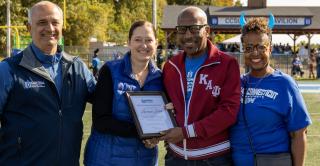
Central honors Admissions Director Larry Hall with Distinguished Service Award


This is an unofficial description for this program. For official information check the Academic Catalog.
The Master of Science degree in Reading and Language Arts is designed to prepare literacy professionals who are knowledgeable and competent in providing quality literacy instruction, who can enhance students' literacy learning, and who meet the standards for reading professionals as defined by the International Literacy Association and by state mandates. The master's program offers three strands:
Strand I: Reading Specialist (30 credits). It is designed to prepare teachers to become reading specialists in compliance with the state standards for advanced certification in Remedial Reading and Remedial Language Arts (102 certification).
Strand II: Literacy Education (30 credits). It is designed to prepare teachers for teaching reading and language arts to diverse groups of students in a classroom context.
Strand III: Literacy & Mathematics Education (30 credits). It is designed to prepare teachers to teach both literacy and numeracy to diverse groups of students in a classroom context.
Program Learning Outcomes
The Master of Science degree program in Reading and Language Arts follows the International Literacy Association's standards for reading professionals. Students in the program are expected to:
-Meet the International Literacy Association's standards for reading professionals.
-Provide leadership, through modeling and mentoring of colleagues, and acquire a wide range of instructional practices to facilitate their reading and writing instruction.
-Be knowledgeable in selecting, administering, and interpreting various assessments appropriate for a wide range of diversity in the classroom, and in communicating results to education stakeholders.
-Create a literate environment to facilitate successful reading and writing for all children.
-Continue to be lifelong learners and scholars, through reading, research, and professional development, and leaders in advocating to advance the professional research base to expand knowledge-based practices.
The candidate's planned program of graduate study will include 30 credits of field study and either a thesis (plan A) that requires an additional 3-credit course (LLA 599) or a Comprehensive Exam (Plan B). A planned program of study will be developed by the candidate and the program advisor. Based on the program advisor's evaluation of candidate's needs, background, and experiences in reading and language arts, a candidate may need to complete additional coursework for certification purposes and therefore the plan of study may exceed the 30 credits.
The strand in Reading Specialist requires 30 credits of courses and a choice between Plan A (Thesis) and Plan B (Comprehensive Exam).
LLA 502 Developmental Reading in PreK-12 3 Credits
LLA 504 Language Arts for First and Second Language Speakers 3 Credits
LLA 508 Teaching Literacy in the Content Areas 3 Credits
LLA 514 Diagnosis and Intervention of Reading and Language Arts Difficulties I 3 Credits
LLA 516 Diagnosis and Intervention of Reading and Language Arts Difficulties II 3 Credits
LLA 518 Clinical Practices in Literacy and Language Arts 6 Credits
The remaining 6 credits come from reading and language arts courses and are decided in consultation with program advisor.
The strand in Literacy Education requires 30 credits of courses and a choice between Plan A (Thesis) and Plan B (Comprehensive Exam).
LLA 502 Developmental Reading in PreK-12 3 Credits
LLA 504 Language Arts for First and Second Language Speakers 3 Credits
LLA 508 Teaching Literacy in the Content Areas 3 Credits
LLA 514 Diagnosis and Intervention of Reading and Language Arts Difficulties I 3 Credits
The remaining 15 credits come from reading and language arts courses and are decided in consultation with program advisor.
The strand in Literacy & Mathematics Education requires 30 credits of courses and a choice between Plan A (Thesis) and Plan B (Comprehensive Exam).
LLA 502 Developmental Reading in PreK-12 3 Credits
LLA 504 Language Arts for First and Second Language Speakers 3 Credits
LLA 508 Teaching Literacy in the Content Areas 3 Credits
LLA 514 Diagnosis and Intervention of Reading and Language Arts Difficulties I 3 Credits
The remaining 15 credits come from mathematics courses recommended by the Department of Mathematical Sciences.
Total Credit Hours: 30