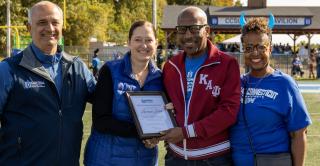
Central honors Admissions Director Larry Hall with Distinguished Service Award


By Julian Layne ’25
In 2000, Rob Dowling walked into New York City’s Circle in the Square Theater to see Sam Shepard’s “True West.” He had been interested in Shepard since he was a teenager, but the production, featuring John C. Reilly and Philip Seymour Hoffman alternating the roles of two estranged brothers, changed the way Dowling saw the playwright’s work.
“It’s about two estranged brothers, indicating the two sides of Shepard,” Dowling says, describing the “rassler” and the “book guy” as two sides of American masculinity.
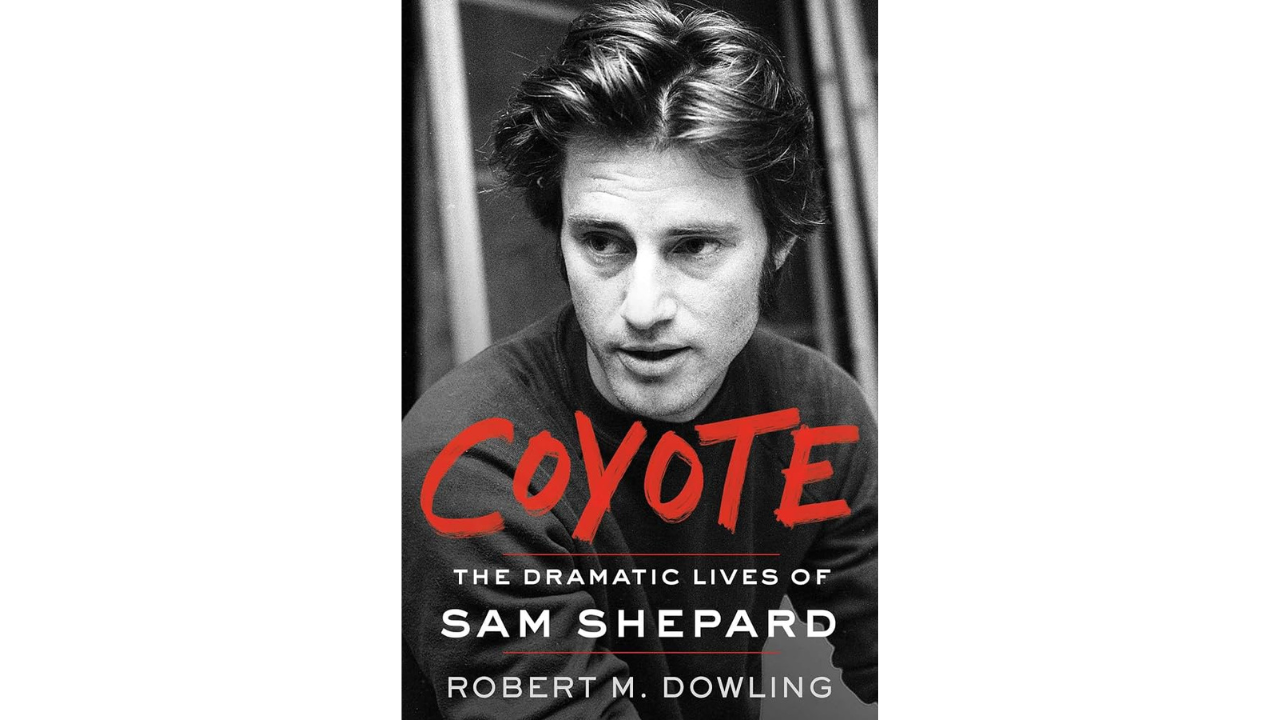
More than two decades later, that fascination became “Coyote: The Dramatic Lives of Sam Shepard,” Dowling’s 2025 biography of the Pulitzer Prize-winning playwright, actor, and screenwriter.
The book represents the latest chapter in Dowling’s scholarship on American playwrights, a path that first took him deep into the life and work of Eugene O’Neill.
Shepard himself considered O’Neill’s “Long Day’s Journey Into Night” the greatest play ever written in America. Dowling saw connections between the two writers in their explorations of dysfunctional families, masculinity and violence, class, psychological identity, and the American Dream.
“After O’Neill, I was well-primed to write about Shepard,” Dowling explains.
Dowling considers O’Neill the most innovative American playwright of the first half of the 20th century and Shepard the most innovative of the second. Shepard’s importance, he said, extends beyond his influence on playwrights. His monologues, western themes, and unconventional approach to theatrical storytelling influenced generations of actors and artists.
While researching “Coyote,” Dowling interviewed actor Ethan Hawke, who recalled seeing “True West” on television.
“I knew, whatever that play was, that’s what I wanted to do with my life,” Hawke told him.
For Dowling, Shepard’s influence can be summed up another way.
“I think of O’Neill as American theater’s novelist, Tennessee Williams as its poet, and Sam Shepard as its musician,” he said.
Getting to that understanding required years of research. Dowling conducted more than 100 interviews with more than 80 of Shepard’s family members, friends, and colleagues, the vast majority of whom had never previously been interviewed about Shepard. He also examined hundreds of private letters, his mother’s diary, family photographs, and his father’s military records and private papers.
That research allowed Dowling to challenge details that had been repeated about Shepard for years. He returned to primary sources to establish accurate premiere dates for Shepard’s plays, even when published versions of the plays contained incorrect information.
The work did not stay on the page.
At Central, Dowling brings his scholarship directly into the classroom through courses in American literature and drama, including American Drama, Eugene O’Neill and Sam Shepard; Sam Shepard and His World; and The American Family Drama.
“Everything I learn, I apply directly to my courses,” he says.
Dowling was originally hired to teach American Realism and Naturalism, and his work on O’Neill and Shepard, he said, has expanded his scope forward in literary history, both as a scholar and as a teacher.
That work is continuing. Dowling has another biography project underway, although he is keeping its subject private for now. He does have a thematic word for the new project.
For O’Neill, it was “suffering.”
For Shepard, it was “fear.”
“For this guy, it’s definitely ‘pressure,’” Dowling says.
Read a review of "Coyote" in The New Yorker.