
Central honors Admissions Director Larry Hall with Distinguished Service Award


Editorial: Prof. Gloria Emeagwali
Abdul Karim Bangura: The Kemetic Roots of Artificial Intelligence:
A Diopian Approach
Casely Ato Coleman: Global Talent Management Trends, AI & Public Policy Implications for Ghana
Dr. Abdul Karim Bangura is one of the world’s most credentialed scholars with doctorates
in Political Science (Howard University, 1987); Development Economics(University of Maryland at Baltimore, 1990); Linguistics (Georgetown University, 1992); Computer Science (Columbus 2001) and Mathematics ( Columbus University). This remarkable scholar is also fluent in several languages, including Swahili, Kikuyu, Mende, Fula, Arabic, Hebrew, French, German, Swedish and English. He has published more than a hundred books. Cheikh Anta Diop, the famous Senegalese Egyptologist is one of his role models. In this issue of Africa Update Dr. Bangura focuses on precursors to Artificial Intelligence in ancient Egypt or Kemet, using a Diopian approach. He is not claiming that ancient Egyptians invented computers but that they created the conceptual architecture and foundation on which AI rests.
Casely Ato Coleman focuses on public policy with reference to contemporary Ghana in his article. He also makes references to AI. The implications of Artificial Intelligence for Human Resource Development is one of the diverse areas of focus of Mr. Coleman who has published extensively. Coleman has devoted decades to diverse aspects of public policy, talent management and resource mobilization and has served in various administrative capacities, as director, coordinator and manager in Plan International , World Vision International , the United Nations Population Fund (UNFPA) and Oxfam International among others. He holds a Master of Philosophy in Public Administration and Organizational Behavior from the University of Bergen, Norway and a Master of Science in Industrial Relations and Personnel Management from the London School of Economics. United Kingdom.
Special thanks go to the two contributors to this issue of Africa Update.
Professor Gloria Emeagwali
Chief Editor, Africa Update
Abdul Karim Bangura
CODESRIA College of Mentors
Dakar, Senegal
Employing the Diopian Restoration of African Historical Consciousness Approach, this essay examines the Kemetic/Ancient Egyptian roots of artificial intelligence (AI). A qualitative methodology undergirds the research and analysis. The essay is divided into five sections: (1) introduction, (2) a general conceptualization of AI, (3) the Diopian Approach, (4) AI in Kemet, and (5) conclusion. The substantive findings prompt me to develop a Kemetic AI theorem. The essay's central premise is that studying the roots of AI in Kemet is crucial for understanding ancient technological capabilities, avoiding past mistakes in current applications, and shaping future innovation. The endeavor also provides context for AI's evolution—from early symbolic reasoning to modern data-driven approaches—and offers insights into the ethical, social, and technical challenges that persist.
Keywords : artificial intelligence (AI), Kemet/Ancient Egypt, Diopian Approach, qualitative methodology, technology, Kemetic AI Theorem
When I began contemplating the Kemetic origins of artificial intelligence (AI), the first question that came to mind—posed by the perennial pessimist—was: "Why must we (i.e., Blacks) romanticize everything?" This essay directly refutes that presupposition. The purpose is to demonstrate that the idea of Kemetic roots of AI is not romanticized nostalgia but historically grounded and analytically defensible.
The central research question is straightforward: Why is the study of the roots of Kemetic AI essential? The underlying thesis is equally uncomplicated: several aspects make this study essential—historical, technological, ethical, and epistemological.
While true electronic AI did not exist in Kemet/Ancient Egypt, the civilization employed automatons and foundational principles of logic and mathematics that mirror modern AI systems. I also demonstrate that today AI is a critical tool for Egyptologists to decipher scripts, reconstruct artifacts, and preserve Kemetic cultural heritage.
To uncover and analyze these features, I utilize the Diopian Restoration of African Historical Consciousness Approach—a qualitative methodology that emphasizes words over numerical values. Before undertaking the analysis, however, sections 2 and 3 present the general conceptualization of AI and the Diopian approach, respectively, to serve as contextual backdrop.
The essay proceeds as follows:
An oft-repeated adage among computer scientists—and especially computational linguists—is this: "As much as there is artificial intelligence, so too there is artificial stupidity." Hence, providing a general conceptualization of AI is imperative for aligning diverse perspectives, enabling responsible development, and managing the profound societal shifts the technology is causing. A clear, high-level understanding allows professionals, policymakers, and the public to move beyond science-fiction myths and grasp AI as a tool that complements human cognitive capabilities by analyzing data and performing complex tasks.
While some readers may feel burdened by yet another definition of a field already replete with definitions, not to offer one here would cause more confusion than it solves. There can be no final definition of AI as long as the field continues to grow.
Three works provide comprehensive coverage of AI's general conceptualization:
| Source | Key Contribution |
|---|---|
| Russell and Norvig (2021) | Hierarchical structure of AI subfields |
| Stryker and Kavlakoglu (2026) | Components, classifications, benefits, and risks |
| Syracuse University (2025) | Approaches to AI functionality |
According to Stryker and Kavlakoglu (2026), AI is a field of computer science (and, I must add, computational linguistics) dedicated to creating systems capable of performing tasks that typically require "human intelligence"—reasoning, learning, problem-solving, perception, and understanding language. Unlike traditional software based on explicit, hand-written rules, modern AI enables machines to learn from data, identify complex patterns, and make independent decisions or predictions.
Based on Stryker and Kavlakoglu (2026), there are five major components:
From Russell and Norvig (2021), four concepts constitute the AI hierarchical structure:
AI Classifications (Stryker and Kavlakoglu 2026):
| Classification | Description |
|---|---|
| Weak AI (Narrow AI) | Designed for specific tasks (e.g., Siri, ChatGPT). All current AI is Weak AI. |
| Strong AI (AGI) | Theoretical AI with human-level intelligence across tasks. |
| Artificial Superintelligence (ASI) | Theoretical AI surpassing human intelligence in all fields. |
Approaches to AI Functionality (Syracuse University 2025):
| Approach | Description |
|---|---|
| Reactive Machines | Respond to inputs in real time without memory (e.g., Deep Blue). |
| Limited Memory | Store past data to improve predictions (e.g., self-driving cars). |
| Theory of Mind/Self-Aware | Highly theoretical future AI understanding emotions and existence. |
Stryker and Kavlakoglu (2026) identify common benefits and risks:
| Benefits | Risks |
|---|---|
| Automation of repetitive tasks | Data bias and unethical outcomes |
| 24/7 availability | Privacy violations |
| Increased speed and accuracy | Job displacement |
| Enhanced decision-making | Long-term existential risks |
The Diopian Approach employed here is the "Diopian Restoration of African Historical Consciousness Methodology." It is a qualitative approach (emphasizing words over numerical values) fundamentally about the revival of African Historical awareness as popularized by Cheikh Anta Diop, a famous African historian, anthropologist, physicist, and politician (Bangura et al. 2019, 214).
Indeed, Diop in his works provided an in-depth historical account of the development of African and Black civilization during the prehistoric period as exemplified in the Nilotic Sudanese civilization which was later known as Egyptian civilization. Diop further stated that the African cultural traditional system, right from its pre-historical era, was/is anchored fundamentally on matriarch-cum-patriarch historiography, as against the predominant masculine Western ideology. Thus, Diopian ideology, which serves as a nucleus to the development of this methodology, emphasizes the principle of African interrelated cultural uniformity and continuity. (Bangura et al. 2019, 214)
Applying the methodology involves utilizing Diop's Africancentric principles to rigorously analyze African history, culture, and social systems. It replaces Western paradigms with scientific, data-driven tests of African cultural continuity, using tools like mathematical modeling to validate historical assertions (Bangura 2018, 2021; Bangura et al. 2019).
| Aspect | Description |
|---|---|
| Foundation in Diopian Thought | Emphasizes the Nile Valley (specifically Kemet) as the cradle of African civilization. |
| Scientific Rigor | Applies quantitative methods—differential equations, mathematical modeling—to test social science axioms (Bangura 2011). |
| Africancentric Paradigm | Interprets African experiences from within the culture, not through Eurocentric frameworks. |
| Application to Modernity | Validates precolonial systems as models for contemporary development. |
| Integration with Other Methods | Used alongside other African-centered methods such as Falolaism (Bangura 2018). |
Three major contributions demonstrate the methodology's application:
The methodology's essentiality lies in Diop's own call: "us Africancentric or African-centered scholars must get back the historical and promethean consciousness encompassed in the achievements of Kemet. Our failure to do so, he said, will leave the history of Black Africans in particular and humanity in general to remain suspended in air" (Bangura 2021, 46).
Diop insisted that "until African historians dare to connect Black Africa with the history of Egypt, Black African history cannot be narrated correctly" (Diop 1974, xiv-xvi; Bangura 2021, 46). He further asserted that "even the study of institutions, languages, etc. cannot be investigated properly until this is done: in a word, it will be impossible to build African humanities, a body of African human sciences, as long as the relationship does not appear legitimate" (Diop 1974, vi; Bangura 2021, 46). It is within this Diopian purview that the Kemetic roots of AI are investigated.
As noted earlier, while AI did not exist in Kemet in the modern computational sense, the civilization's philosophies and technologies provided the early conceptual foundations for what we now call AI. Kemet developed foundational early automata and complex engineering principles traditionally seen as precursors, with key examples ranging from roughly 4000 BCE to 200 BCE. These developments included automated statues and advanced mathematical models. Today, modern AI is used extensively as a tool to decode and reconstruct the mysteries of the Kemetic era.
For clarity, the rest of this section is divided into three subsections: (1) conceptual precursors, (2) AI as a modern Egyptological tool, and (3) the Edwin Smith papyrus as a case study.
Siboli Mukherjee (2026) identifies four ways Kemetic culture mirrored AI concepts through its approach to data and automation:
| Precursor | Description | Modern Parallel |
|---|---|---|
| Symbolic Knowledge Representation | Hieroglyphics and temple archives functioned as structured systems with interconnected associations. | Knowledge graphs, neural networks |
| Predictive Analytics | Mathematical modeling predicted Nile flood patterns and managed resources. | AI-driven climate & financial forecasting |
| Early Automatons | Mechanical statues believed to possess wisdom and move independently. | Embodied AI, robotics |
| Pursuit of Immortality | Mummification preserved identity beyond physical death. | Digital avatars, personal AI |
Significance : These precursors represent the earliest recorded instances of algorithmic thinking, predictive analytics, symbolic representation, and automated simulation of intelligence. By demonstrating that structured intelligence and automation are not modern inventions, they provide historical context showing that foundational principles of today's technologies are rooted in structured approaches developed thousands of years ago.
Wilbrink and Roberson's (2023) work on "Cleo: The Artificial Intelligence Egyptology Platform" reveals how specialists now use machine learning to bridge historical gaps previously impossible to cross. They delineate four tools:
| Tool | Application |
|---|---|
| Deciphering Hieroglyphs | Projects like Google's Fabricius use ML to recognize and translate complex hieroglyphic signs. |
| Virtual Reconstruction | AI digitally restores erased inscriptions, reconstructs ancient faces, and simulates pyramid construction. |
| Interactive Learning | The Rosicrucian Egyptian Museum features a robotic embodiment of Thoth that converses with visitors. |
| Archaeological Search | Platforms like Cleo act as intelligent aggregators for museum collections. |
Essence : AI as a modern Egyptological tool accelerates data analysis, decodes dead languages such as ciKam, and virtually preserves Kemet's endangered heritage. It acts as an intelligent partner that enhances human expertise rather than replacing it, enabling the "resurrection" of Kemetic voices through machine learning, computer vision, and predictive modeling.
According to the classic work on neurology by Robert H. Wilkins (first published 1965, republished 1992), the Edwin Smith Papyrus is the world's oldest known surgical text. It is a seventeenth-century BCE Kemetic document on trauma surgery, detailing forty-eight cases with a rational, analytical approach to diagnosis, prognosis, and treatment, including the first known description of the brain and its functions. It is preserved at the New York Academy of Medicine.
The Britannica Editors (2025) identify six major features:
| Feature | Description |
|---|---|
| Content | 48 case studies of injuries to the head, neck, and torso. |
| Structure | Each case follows: description, diagnosis, prognosis, treatment. |
| Medical Insights | Knowledge of pulse, brain function, sutures, bandages, antiseptics. |
| Methodology | Inductive, scientific approach with objective examination methods. |
| Origin | Dated ~1600 BCE, copied from an older text, written in hieratic script. |
| Discovery | Acquired by Edwin Smith in 1862, now at the New York Academy of Medicine. |
Using AI to analyze the Edwin Smith Papyrus, Khalpey, Amer, and Abraham (2026) demonstrate how natural language processing and digital imaging can reanalyze Kemetic medical texts to inform contemporary clinical thought. Their review emphasizes four major themes:
| Theme | Contribution |
|---|---|
| Reanalyzing Primary Texts | AI addresses textual degradation and translation ambiguity. |
| Clinical Reasoning Origins | The papyrus's case-based format is an early precedent for modern surgical triage. |
| Pharmacological Reassessment | Approximately 28% of Kemetic remedies retain therapeutic value under modern analysis. |
| Bridging the Gap | Machine learning synthesizes Kemetic medical wisdom with modern surgical precision. |
The substantive findings in the preceding section enable me to propose a Kemetic AI theorem, diagrammatically depicted in Figure 1. The theorem shows how the main concepts or variables (MC) can facilitate a comprehensive understanding of Kemetic AI (KAI), and vice versa, represented in the following equation:
MC = KAI
where:
The basic proposition is that these concepts/variables are all necessary to achieve a comprehensive understanding of Kemetic AI, and vice versa.
Figure 1: A Comprehensive Understanding of Kemetic AI
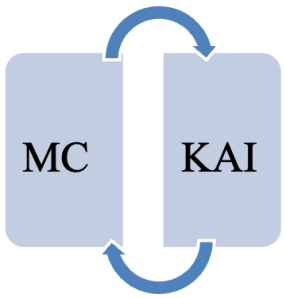
Source: Generated by the author
A comprehensive understanding of Kemetic AI can be characterized as comprising a "broad theorem." As Ralph Fasold (1984) and I (Bangura 1991, 2006) have systematically demonstrated, a "broad theorem" is present when there is the "presence of highly valued segments of scholarly epistemological repertoire for situations perceived as more formal and guarded; and the reservation of less highly valued segments, of any degree of epistemological relatedness to the higher valued segments, for situations perceived as more informal and intimate" (Bangura 1991, 7).
Returning to the research question posed in the introduction— Why is the study of the roots of Kemetic AI essential? —the evidence demonstrates five compelling reasons:
In essence, the Kemetic roots of AI are not a romantic fantasy but a verifiable historical and intellectual lineage. The Kemetic AI theorem proposed here offers a structured way to conceptualize this heritage—not as a claim that ancient Egyptians built computers, but as a recognition that they built the conceptual scaffolding upon which modern AI rests. As Diop insisted, to deny this connection is to leave African history—and, by extension, human history—suspended in air. This essay has attempted to bring it back to solid ground.
Bangura, Abdul Karim. 1991. Multilingualism and Diglossia in Sierra Leone . Lawrenceville, VA: Brunswick Publishing Corporation.
Bangura, Abdul Karim. 2006. "The Krio Language: Diglossic and Political Realities." In New Perspectives on the Sierra Leone Krio , edited by Mac Dixon-Fyle and Gibril Cole, [page range]. New York: Peter Lang.
Bangura, Abdul Karim, ed. 2011. African-Centered Research Methodologies: From Ancient Times to the Present . San Diego, CA: Cognella.
Bangura, Abdul Karim, ed. 2012. Fractal Complexity in the Works of Major Black Thinkers , Volume One. San Diego, CA: Cognella.
Bangura, Abdul Karim, ed. 2013. Fractal Complexity in the Works of Major Black Thinkers , Volume Two. San Diego, CA: Cognella.
Bangura, Abdul Karim, ed. 2015. Fractal Complexity in the Works of Major Black Thinkers , Volume Three. San Diego, CA: Cognella.
Bangura, Abdul Karim. 2018. Falolaism: The Epistemologies and Methodologies of Africana Knowledge . Durham, NC: North Carolina Academic Press.
Bangura, Abdul Karim. 2021. "Ŝankhu: A Meta-Analysis of Research on Financing Sustainability in Africa from a Diopian Perspective." African Development Finance Journal 6 (1): 45-65. http://journals.uonbi.ac.ke/index.php/adfj .
Bangura, Abdul Karim, ed. 2026. Socioeconomics, Philosophy, and Deneocoloniality: Exploring the Economic Impact of Colonialism and Neocolonialism across Africa and Its Diaspora . New York: Palgrave Macmillan.
Bangura, Abdul Karim, Joseph A. Obando, Ishmael I. Munene, and Chris Shisanya, eds. 2019. Conducting Research and Mentoring Students in Africa: CODESRIA College of Mentors Handbook . Dakar, Senegal: CODESRIA Publications.
Britannica Editors. 2025. "Edwin Smith Papyrus." Encyclopedia Britannica . https://www.britannica.com/topic/Edwin-Smith-papyrus .
Diop, Cheikh Anta. 1974. The African Origin of Civilization: Myth or Reality . Chicago: Lawrence Hill.
Fasold, Ralph. 1984. The Sociolinguistics of Society . New York: Basil Blackwell.
Khalpey, Zain, Hossam Amer, and Alyssa Abraham. 2026. "Decoding the Past, Informing the Future: Artificial Intelligence as a Bridge Between Ancient Egyptian Medical Knowledge and Modern Surgical Practice." Cureus . https://assets.cureus.com/uploads/review_article/pdf/412074/20260331-42843-7f5oxg.pdf .
Mukherjee, Siboli. 2026. "Echoes of the Pharaohs: How Egyptian Civilization Shapes the AI Revolution: AI and the Wisdom of Ancient Egypt." History . https://vocal.media/history/echoes-of-the-pharaohs-how-egyptian-civilization-shapes-the-ai-revolution .
Russell, Stuart J., and Peter Norvig. 2021. Artificial Intelligence: A Modern Approach . Hoboken, NJ: Pearson. https://www.pearson.com/en-us/subject-catalog/p/artificial-intelligence-a-modern-approach/P200000003500/9780137505135 .
Stryker, Cole, and Eda Kavlakoglu. 2026. "What Is Artificial Intelligence (AI)?" IBM. https://www.ibm.com/think/topics/artificial-intelligence .
Syracuse University School of Information Studies. 2025. "Types of AI: Explore Key Categories and Uses." March 26, 2025. https://ischool.syracuse.edu/types-of-ai/ .
Wilbrink, Heleen, and Joshua Aaron Roberson. 2023. "Chapter 23: Cleo—The Artificial Intelligence Egyptology Platform." In Ancient Egypt, New Technology , Harvard Egyptological Studies 17. Leiden: Brill.
Wilkins, Robert H. 1992. Neurosurgical Classics . 2nd ed. Park Ridge, IL: American Association of Neurological Surgeons. First published 1965.
Casely Ato Coleman
Two important reports have been published recently that reveal significant megatrends in the global talent management ecosystem with public policy implications for Ghana. In this reflection note, we examine key highlights of the two reports as well as trends in the "gig economy" and from an organizational design perspective, discuss their implications for public policy decisions addressing youth and graduate unemployment in Ghana.
PWC has released the Future of Work 2026 report ( https://fortune.com/2026/06/18/entry-level-work-ai-pwc-seniorization-report/ ), and there are megatrends unfolding that have implications for Ghana's efforts to address youth unemployment. It is clear that AI is creating a two-track labor market: jobs that are not affected by AI and jobs that have been enhanced by AI. We view this as job enrichment via AI, which is a positive development. In the same vein, AI has transformed entry-level work—entry-level positions have not vanished, but the job design, profile, and expectations have been transformed without warning, and many fresh graduates are virtually unprepared.
This has implications for career counseling, support, and resources to enable fresh graduates to transition to the labor market. There are key mission-critical skills in the era of AI that cannot be performed by AI—strategic decision-making, stakeholder management, leadership, and judgment, among others. This aspect of the PWC report reinforces some of the author's earlier reflections a few years ago around AI, organizational redesign, knowledge management, and organizational culture (see Coleman 2018a, 2018b).
The 236-page International Labor Office World of Work Series 2026 report ( https://lab.ilo.org/world-work-series/lifelong-learning-and-skills-future ) argues for a holistic vision of lifelong learning that advances economic, social, civic, and environmental goals. Beyond formal education, it supports workers' access to decent employment at different ages, enterprise innovation, and societal well-being. It also reveals a worrying fact: quality training is out of reach for many workers and is highly unequal. Especially low-qualified and informal workers and those in smaller enterprises lack access to quality training leading to recognized skills and qualifications. This deepens inequalities, as lifelong learning fosters resilience in light of the digital, green, and demographic transitions.
As an HR practitioner and researcher, what attracted my attention most are the data and insights showing that a narrow focus on technical skills, including AI and green tasks, is not enough. The key skills—socio-emotional and cognitive skills—consistently rank among the most demanded skills across countries. Socio-emotional skills: subcategories mentioned in vacancies are character skills, social skills, people management, customer service skills, and so forth. Cognitive skills include core cognitive skills, sophisticated cognitive skills, general computer skills, software-specific skills and technical support, machine learning and AI skills, financial skills, writing skills, and project and process management skills. There is significant demand for digital, technical, and sustainability-related skills. The report also indicates that training pays off, but program design matters, since well-designed training programs improve employment outcomes particularly for disadvantaged groups, especially when training is combined with complementary support and leads to qualifications. It indicates that delivery often lags behind ambitious goals for cohesive lifelong learning systems, and institutional data shows that widespread fragmentation and weak implementation constrain progress. This author believes that there are significant duty-bearer accountability issues raised by the report across ILO member countries.
According to Charles Kerchner (2026) in a forthcoming publication on fulfilling jobs, in the developing world, "the tried-and-tested model of industrialization has run out of steam." In a perhaps unexpected way, the underlying problem has converged. Fulfilling jobs help address inequality, exclusion, and spatial and social segmentation. Lack of fulfilling jobs creates loss of trust in duty bearers. The path toward good jobs in Ghana is not a choice between governments and markets. It requires an integration of efforts between the two that is aligned with the current global "gig" talent management ecosystem.
Many Ghanaian youths rely on the gig economy, which is mediated by computers and digital communication. It has emerged as a transformative factor in Ghana's labor market, reshaping how services are delivered, consumed, and monetized. The "gig" economy, using digital platforms, facilitates interactions between producers and consumers; this economy encompasses a wide array of services, from ride-sharing and freelance work to e-commerce and content creation.
The gig economy opens several doors for Ghanaian youth, where formal employment is limited or difficult to access. There are emerging pivots in the global labor market that offer low-barrier access to work on a flexible basis. For example, Upwork and Fiverr allow freelancers to monetize skills in writing, graphic design, programming, translation, and so forth. Uber and Bolt provide gig work in ride-hailing, particularly in urban centers in Ghana. In the formal labor market sector, Shortlist helps NGOs and educational institutions match job seekers to employers in Africa. Yoma (Youth Agency Marketplace), backed by UNICEF and the African Union, enables African youth to build digital CVs and access income-earning microtasks and learning and development opportunities.
According to Kerchner (2026), across the world, these platforms are also being adapted by youth cooperatives and local governments to aggregate gig workers for shared access to clients and insurance. In the case of Ghana, we believe that the government can partner with industry and academia to prioritize, invest in, and scale up some of these talent management pathways in an integrated manner to address youth unemployment in response to the global megatrends in the international and local talent management ecosystems.
Another significant megatrend is the application of technology-enabled platforms that match labor to tasks and serve as sites for skill acquisition and demonstration. In the last fifteen years, the author has personally partnered with many service providers to design and implement learning management systems to drive skills development in industry. One such case study was published recently (Coleman 2026b). For example, Coursera and Udemy offer affordable or free courses in coding, marketing, entrepreneurship, and AI, many with certification options. Kaggle is a platform for data science competitions, ideal for youth in technical fields to gain experience, network, and even earn an income. Toptal provides a platform for highly skilled freelancers (especially in software and finance), often used to transition into global consulting careers.
Generation.org , founded by McKinsey, partners with employers and governments to train and place youth into jobs using a hybrid online model; their scope of operations includes Ghana. Andela, originally launched to train African software engineers, has become a platform for global tech placements and training. Google Career Certificates are delivered via Coursera but implemented by many workforce development nonprofits and libraries. Digital Opportunity Trust (DOT), a Canada-based NGO, works globally to train youth in digital literacy and leadership, especially through peer-based training and platform-supported learning. Remote OK and AngelList Talent connect remote workers to startup and tech jobs globally, particularly suited for skilled digital workers.
In a recent LinkedIn publication, Dave Ulrich (2026), the #1 global HR thought leader, introduces the concept of "a portfolio career." This is a personalized journey where an individual takes ownership and accountability for multiple work experiences. This personalized portfolio career might include public service, working in nonprofits, shared positions, entrepreneurship, part-time work, social media influencing, consulting, gig work, technology (app) creation, copywriting, tutoring, virtual assistance, event hosting, and so forth. Ulrich argues that, as with all work, AI can provide information about how to perform many of the technical tasks in each work setting, and personal experiences in different work settings can be used to help an individual talent learn social and cultural skills. We argue that this is a pragmatic talent management and development pathway toward dealing with the megatrends in the current technology-driven global talent management ecosystems.
In the case of Ghana, the implications are obvious.
The PWC 2026 report, the AI Job Barometer Report 2026, and the ILO 2026 report all call for member countries to strategically focus on an integrated talent management and talent development strategy that creates an intersection of education, skills development, coaching, and strategic alliances with industry, academia, and NGOs. In this reflection note, we discussed the implications of the reports for youth talent management in Ghana. We submit that there will be a need for strong duty-bearer accountability to ensure governance, institutional collaboration, sustainable resource acquisition and financing, and social dialogue to address youth unemployment and provide sustainable and fulfilling jobs. Employers also have a role to redesign work to align with changes happening in the global labor market to support youth to thrive. We aver that this approach lays the foundation for Ghana's youth to be nimbly prepared with the right cognitive and socio-emotional skills to thrive in increasingly complex global and local talent management ecosystems.
Coleman, Casely Ato. 2018a. "Artificial Intelligence: Managing Expectations." LinkedIn. https://www.linkedin.com/pulse/artificial-intelligence-managing-expectations-casely-ato-coleman/ .
Coleman, Casely Ato. 2018b. "Artificial Intelligence: Implications for HR and Organizational Redesign." LinkedIn. https://www.linkedin.com/pulse/artificial-intelligence-implications-hr-redesign-casely-ato-coleman/ .
Coleman, Casely Ato. 2026a. "Reset in Management Education and Bridging the Gap between Academia and Industry." IMANI Africa . https://imaniafrica.org/2026/05/reset-in-management-education-and-bridging-the-gap-between-academia-and-industry/ .
Coleman, Casely Ato. 2026b. "Building Leaders for the Future: An Example of Talent Management and Succession Planning in Global Organisations." European Journal of Human Resource Management Studies 10 (1). https://oapub.org/soc/index.php/EJHRMS/article/view/2178/2739 .
International Labor Office. 2026. The World of Work Series 2026: Lifelong Learning and Skills for the Future . https://lab.ilo.org/world-work-series/lifelong-learning-and-skills-future .
Kerchner, Charles. 2026. "Humanity Intelligence Needs Fulfilling Jobs for Peace, Prosperity, and the Planet." Forthcoming.
PWC. 2026. Future of Work 2026 Report . https://fortune.com/2026/06/18/entry-level-work-ai-pwc-seniorization-report/ .
Ulrich, Dave. 2026. "AI, Organization Form, and Personalized Career: The Chameleon Employee." LinkedIn. https://www.linkedin.com/pulse/ai-organization-form-personalized-career-chameleon-employee-ulrich-azmsc/ .