
Focus on Scholarship
Stephen Balkaran
Tracing the Steps of the Civil Rights Movement
Stephen
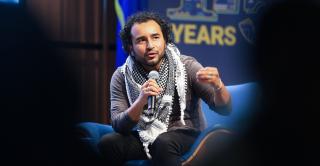
Balkaran, at 38, wishes he had lived during the days of the Civil Rights
Movement in this country. “Imagine getting to meet Martin Luther King,” he
remarks in hushed tones. His students listen intently. “Understand, this man
was committed to striving for equality—with drive, persistence, and courage. He
faced down bomb threats, assassination attempts, and being jailed for marching peacefully,
as well as enduring intimidation by the Klan and white supremacists.”
Balkaran,
an adjunct lecturer in philosophy, raises consciousness in his students whether
he’s teaching courses in African American Studies, American Philosophy,
Philosophy of the Civil Rights Movement, or 21st Century Civil Rights and
African American Politics.
He
declares, “I want my students to feel how vivid and moving the images of the
Civil Rights Movement are so they will fully grasp the meaning of segregation
as seen in White Only signs, in Rosa Parks refusing to sit at the back of the
bus, in news photographs showing police brutality, in James Meredith walking to
class at the University of Mississippi in 1962 accompanied by US marshals.”
No Time Limit on Fighting for Human Rights
One day Balkaran described to
students how the Montgomery Bus Boycott pressed for a more humane public
transportation system. Some 50,000 African Americans mobilized, and the boycott
lasted 381 days until the local segregation ordinance was lifted on public buses.
A student asked, “Why didn’t they give up after, say, 200 days?” Balkaran
asserted, “There’s no time limit on fighting for human rights and freedom.”
Balkaran
holds firm convictions about human rights and social justice. Having emigrated from
his native Trinidad some 20 years ago, he earned undergraduate and graduate degrees
in political science from the University of Connecticut. After receiving a
second master’s in international relations in 1997 from UCONN, he worked as a
research associate in third world economic development for the United Nations
and then as a consultant to the World Bank.
Balkaran’s
immersion in civil rights and human rights issues deepened with his role as
assistant director of UCONN’s African National Congress project. He archived ANC
(Nelson Mandela’s ruling party in South Africa) documents detailing apartheid conflicts.
It was
while Balkaran was a research fellow at Yale University (he also was a research
fellow at Harvard) that he worked with prominent Civil Rights Movement figure Kathleen
Cleaver, former wife of Eldridge Cleaver, a Black Panther Party leader. “I’m indebted
to Kathleen for her insights into what it means to be an activist and scholar,”
observes Balkaran. Kathleen Cleaver is a professor of law in the African
American Studies department at Yale.
Balkaran
traveled south in the summer of 2005 to make a personal pilgrimage, retracing
the steps of the Civil Rights Movement. In Montgomery, he felt the palpable
presence of Rosa Parks and of King preaching at the Dexter Ave. Baptist Church.
In Selma, he imagined the intimidation used to terrify black voters. Finally,
at the Lorraine Motel in Memphis, Tennessee, Balkaran stood on the balcony
where King was assassinated. “Such a journey is haunting every step of the way.
Right then and there, I vowed I’d develop a field study course to illustrate in
a powerful way the Civil Rights struggle,” says Balkaran.
One of a Kind Civil Rights Project
He did just
that, developing the Civil Rights Project at CCSU. Balkaran acknowledges the support
of Associate Vice President of Academic Affairs Joseph Paige in bringing about
the week-long course. This summer, Balkaran will guide some 20 CCSU students
along a carefully laid out route— from Montgomery to Birmingham, Selma, Memphis,
and Atlanta—tracing historic events in the Civil Rights Movement. “To my
knowledge, CCSU is the only university in America with a course that literally
walks the Civil Rights Movement,” Balkaran says.
In
Montgomery the class will follow the footsteps—and strategies—of Rosa Parks and
the Montgomery Bus Boycott, then meet and interview people—both blacks and
whites— from the Montgomery community about their experiences and struggles
during the historic era. At the Dexter Ave. Baptist Church, students will
relive the early stages of King’s long, nonviolent struggles.
After
consulting resources of the Civil Rights Museum in Birmingham, students will do
research, interview former and current police officials in the Birmingham
Police Department, and collect oral histories describing the use of police
brutality and the rise of campus security during the period. Patrick Williams, president
of CCSU’s Black Student Union, comments, “I’m anticipating a great trip. This class
will be one of the best learning tools to see what the people we admire fought
for and to see the conditions they were living in. We’ll
be able to learn from people who were actually part of the movement. It will be
an opportunity to take a walk into history, a history not taught as often as it
should be.”
Following the
Selma-to-Montgomery March route, students will have the opportunity to imagine
what is was like to be demonstrators demanding fairness in voter registration.
Final destinations for the class will be the Lorraine Motel in Memphis and the
King Center in Atlanta. “One of the goals for this Civil Rights Project is for
students to consider the tragedy of the death and the affirmation of the legacy
of Martin Luther King, Jr.,” observes Balkaran. “I hope students come away with
a fuller understanding of one of the most critically important eras in modern
American life, and of the enduring significance of race in the nation’s
history.”
—Geri
Radacsi